What Is Software Quality Assurance (QA)? A Business Owner’s Guide

Picture this: your team spent six months building a customer-facing app. You launch. The first 50 users hit a crash loop on sign-up. Your inbox fills with support tickets. A bad review lands on the App Store before you’ve had your morning coffee. That scenario plays out dozens of times a day at companies that treated quality assurance as an afterthought. Software quality assurance is the practice of building and maintaining processes that catch defects before your users do. It is not a single activity, a stage at the end of a project, or something only enterprise teams need. It is a discipline — and this guide explains what it covers, why it matters to your bottom line, and what to ask any development partner before you sign a contract.
What Is Software Quality Assurance?
Software quality assurance (QA) refers to the planned, systematic activities a development team follows to ensure that a software process — and the product it produces — meets a defined standard of quality. According to the International Software Testing Qualifications Board (ISTQB), QA encompasses the policies, standards, procedures, and audits that govern how software is built, not just how it is tested.
The most common misconception: QA and testing are the same thing. They are not. Testing is one activity within QA — specifically the execution of test cases to find defects. QA is the discipline that governs when, how, and what to test, and what happens to a bug once it is found. A team that runs tests but has no documented test plan, no acceptance criteria, and no regression suite is testing, not doing QA.
QA vs. QC (Quality Control): What’s the Difference?
These terms are often conflated. The practical distinction is this: QA is about preventing defects; quality control (QC) is about detecting them.
| Quality Assurance (QA) | Quality Control (QC) | |
|---|---|---|
| Focus | Process | Product |
| Timing | Throughout development | After build or release |
| Goal | Prevent defects | Detect defects |
| Who | QA engineers + dev team | Testers, reviewers |
In mature development shops, both exist in parallel. QC catches what slips through; QA works to narrow that gap over time so fewer defects slip through at all.
Why QA Matters for Your Business (Not Just Your Dev Team)
If you are evaluating a development partner, the case for QA is not technical — it is financial and reputational.
Defects found in production cost dramatically more to fix. Research cited by NIST and IBM consistently places the cost multiplier at 6–15× when comparing production defects to defects caught during development. A bug that a QA engineer catches in week three of a sprint costs your vendor an hour to fix. The same bug discovered by a user after launch costs you customer trust, support hours, an emergency hotfix, and possibly downtime. The math is not subtle.
Your reputation is your product. One viral review — “the app crashed and lost my data” — outweighs months of marketing spend. App store ratings are a permanent, public record of your product’s quality. Poor QA compounds into poor ratings, which compounds into lost organic installs. Mobile apps, in particular, are judged by the average of their lowest moments.
Regulatory exposure is real in many verticals. Fintech, health-tech, and ed-tech applications face compliance requirements — PCI DSS, HIPAA, FERPA — that QA processes help satisfy. A documented test plan with defined acceptance criteria is evidence of due diligence if a compliance audit occurs. Absence of documentation is evidence of the opposite.
Customer retention hinges on reliability. Studies consistently show that users abandon applications after one or two poor experiences. The cost of re-acquiring a churned user typically exceeds the cost of the QA that would have kept them.
The 7 Main Types of Software Testing in QA
Competitors in the developer space enumerate testing types extensively. Here is what each type means in plain English, and when it happens in a real project.
| Testing Type | What It Checks | When |
|---|---|---|
| Unit Testing | Individual functions or components in isolation | During development, written by developers |
| Integration Testing | How modules interact with each other | After unit testing, before release |
| Functional Testing | Does the software do what the specification says? | Before release |
| Regression Testing | Do new changes break existing features? | After every update or sprint |
| Performance Testing | Speed, load capacity, stability under stress | Pre-launch and after major changes |
| Security Testing | Vulnerabilities, authentication gaps, data exposure | Pre-launch and ongoing |
| User Acceptance Testing (UAT) | Does the product meet business requirements? | Final gate before go-live |
Each type serves a distinct purpose. The absence of any one of them creates a corresponding blind spot. A product can pass all functional tests and still fail performance testing under real-world load — that is why the full suite matters.
How QA Fits Into the Software Development Life Cycle
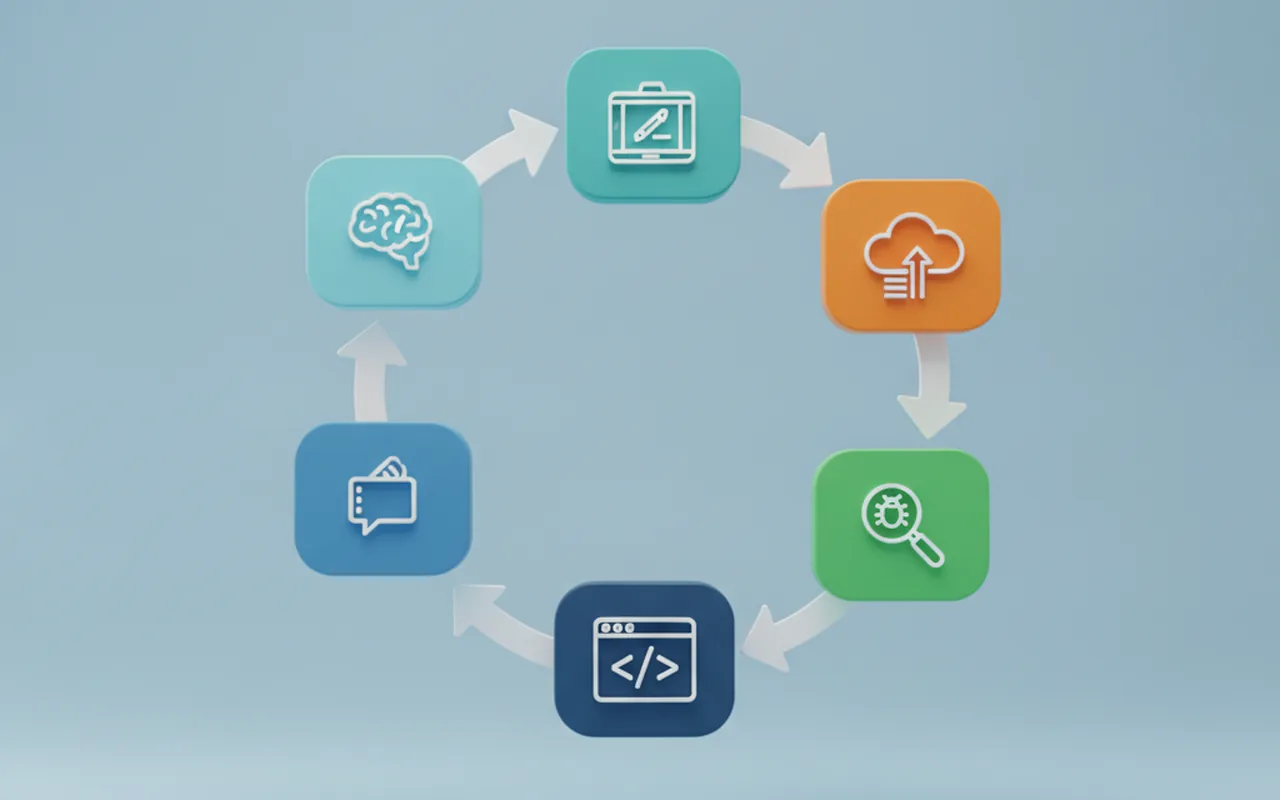
The most common mistake non-technical business owners make when reviewing proposals is assuming QA is a phase that happens after development. It is not. In modern development practice, QA is a parallel track that runs alongside every phase of the software development life cycle — from requirements gathering through deployment.
This approach is called shift-left testing: moving quality activities as early as possible in the development process, where defects are cheapest to catch. A QA engineer reviewing a requirements document in week one will flag ambiguities that would have generated five separate bug reports in week eight.
The Software Testing Life Cycle (STLC) — 5 Phases
- Requirements Analysis. The QA team reviews specifications alongside developers, flagging ambiguous requirements before a single line of code is written. If a requirement can be interpreted two ways, it will be implemented one way and tested another.
- Test Planning. Scope, resource allocation, timelines, tools, and test environments are defined. This document becomes the contract between QA and the rest of the team.
- Test Case Design and Development. Test cases are written for every defined feature: the happy path, the edge cases, the error states. Test data is prepared.
- Test Execution. Tests run against the build. Defects are logged in a shared bug-tracking tool (Jira, Linear, GitHub Issues) with severity, reproduction steps, and screenshots. Developers fix; QA re-tests.
- Defect Reporting and Closure. Each defect passes through a formal closure process — fixed, verified, closed. Sign-off confirms the build is ready to advance to the next phase.
The key insight: QA engineers are not idle between these phases. They are continuously writing test cases for upcoming features, running regression suites on shipped code, and updating documentation as requirements evolve.
QA in Agile vs. Waterfall Projects
The methodology your development partner uses shapes how QA is structured. Understanding the difference helps you ask better questions during vendor selection. Most modern teams use some form of agile, Scrum, or Kanban.
In waterfall projects, development phases are sequential: requirements, design, development, testing, deployment. QA is a defined phase that begins only after development is “complete.” The problem: if a foundational architectural decision was wrong in week two, QA discovers it in week twelve — at maximum cost and maximum schedule impact.
In agile projects, QA is integrated into every sprint. A two-week sprint might include a QA engineer writing test cases for features being designed, executing tests on features developed in the previous sprint, and running regression tests on the full build before the sprint demo. Defects surface within days of being introduced, not months. Feedback loops are tight, and quality is a continuous property of the codebase rather than a checkpoint at the end.
The practical question to ask a vendor: “At what point in a sprint does a feature get tested, and who is responsible for regression coverage?” A vendor who says “we test before we release” is describing waterfall QA. A vendor who describes a continuous testing process with sprint-by-sprint regression suites is describing agile QA.
Manual Testing vs. Automated Testing: What Business Owners Need to Know
Manual testing means a human tester follows a test case and observes the result. It is essential for exploratory testing, UX evaluation, and edge cases that are difficult to script. Humans catch things scripts do not: “this button text is confusing,” “this error message makes no sense.”
Automated testing means scripts execute test cases programmatically. Selenium, Cypress, and Playwright are common tools for web applications; Appium covers mobile. Automated tests run faster, run consistently, and can execute thousands of regression checks overnight. They are cost-effective at scale but require upfront investment to write and maintain.
Most mature QA strategies follow the testing pyramid: a large base of fast, cheap unit tests (automated, written by developers); a middle layer of integration tests (automated); and a small apex of end-to-end tests that simulate full user journeys (automated or manual). The ratio shifts as the product matures.
The right question for your vendor is not “do you do automated testing?” — any vendor will say yes. The right question is: “What is your testing strategy and how does the automation-to-manual ratio change across the project lifecycle?” A thoughtful answer signals a thoughtful QA process.
What Good QA Looks Like in a Development Contract
When you are reviewing a proposal from a development partner, use this checklist to evaluate QA maturity. Absence of any item is a meaningful signal.
- QA plan is in scope from day one. If testing is described as an add-on service rather than a core deliverable, that is a red flag.
- Test cases are documented and deliverable. You should receive test documentation at the end of a project, not just a list of closed tickets.
- Bug tracking is transparent. You should have read access to the shared issue tracker throughout the project — not just a weekly summary from your project manager.
- The regression suite grows with every sprint. New features must not be shipped without confirming they have not broken old ones.
- UAT is a formal gate. The software should not go live without your explicit sign-off, preceded by a structured user acceptance testing period.
- Performance benchmarks are defined upfront. “It should be fast” is not a benchmark. “Page load under 2 seconds for 500 concurrent users” is.
A professional custom software development partner will include a QA plan in their initial proposal — if they do not mention testing until you ask, that is a yellow flag. For further reading on industry-standard QA frameworks, the ISTQB Foundation Level syllabus is the most widely adopted reference in professional software testing.
How Much Does QA Add to Project Cost?
The industry norm is that QA represents 15–25% of total project budget for professionally managed software projects. The range varies by complexity: a simple CRUD web application sits at the lower end; a mobile fintech product with regulatory compliance requirements sits at the higher end.
Frame QA spend as insurance, not overhead. An hour of QA work can prevent 10 hours of production hotfixes. Consider a typical mid-size project: a $150,000 development engagement. The QA allocation is roughly $22,500–$37,500. A single production incident — emergency developer time, customer support, potential customer churn, potential SLA penalties — can easily exceed that. Most do.
What QA budget typically covers: QA engineer time, testing tools (Selenium, Cypress, Postman for API testing), bug-tracking tooling, and test environment infrastructure. What it does not cover: your own team’s time for user acceptance testing (that is client-side time), and third-party security penetration testing (typically billed as a separate engagement).
Common QA Mistakes to Avoid
- Starting QA after development is finished. This is the single most expensive mistake. By the time QA begins, architectural problems are baked in and regression testing finds them at maximum cost.
- Treating QA as optional in “MVP” projects. Your MVP is your public debut. Its quality sets the baseline expectation for every user who encounters your product at its most influential moment — first use.
- Skipping regression testing after every update. Each deployment introduces risk. Without regression coverage, you cannot know whether last week’s working features survived this week’s changes.
- Not defining acceptance criteria upfront. “It’s a bug” is subjective without agreed acceptance criteria. Defining done early prevents scope disputes and allows QA to write meaningful test cases.
- Confusing UAT with QA. User acceptance testing confirms that the software meets business requirements from the client’s perspective. QA ensures technical quality throughout the entire build. They are complementary, not interchangeable.
Frequently Asked Questions
What is the difference between QA and testing?
QA is the broader discipline of ensuring quality processes are followed throughout development. Testing is one activity within QA — specifically the act of executing test cases to find defects. QA encompasses planning, standards, audits, and continuous process improvement; testing is the execution layer within that framework.
When should QA start in a software project?
QA should start at the requirements phase, before any code is written. The earlier a defect is identified — even a requirement ambiguity that would have produced a defect — the cheaper it is to address. The cost of fixing a defect scales steeply as development progresses; production defects are the most expensive by a factor of six to fifteen.
Do I need a dedicated QA engineer or can developers test their own code?
Developers should write unit tests, but independent QA engineers catch issues developers cannot see due to familiarity bias: the developer who wrote a feature will naturally test the happy path, not the edge cases they did not consider. For projects over three months or serving more than a few hundred users, a dedicated QA resource delivers a return on investment that is straightforward to calculate.
What is regression testing and why does it matter?
Regression testing re-validates that existing features still work after new code is added. Without it, every release introduces risk that something previously working has broken. In agile development where code changes weekly, a maintained regression suite is the only way to ship with confidence rather than with fingers crossed.
What is the difference between QA and UAT?
QA is conducted by the development team throughout the build to verify technical quality — that the code does what it is supposed to do. User acceptance testing is conducted by the client or end users near launch to confirm the software meets business requirements — that the software does what you actually needed it to do. Both are necessary; neither substitutes for the other.