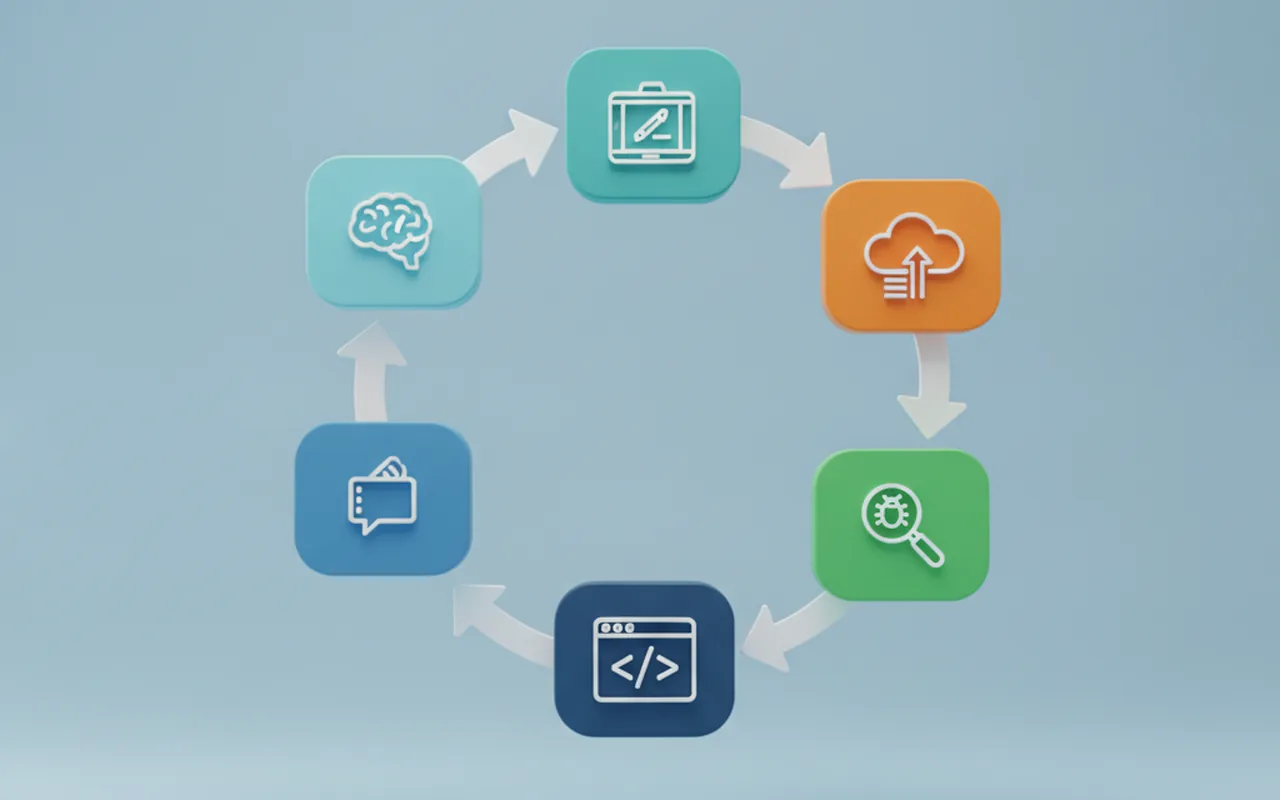
Agile vs Scrum vs Kanban: Which Framework to Choose in 2026

Teams routinely call everything “Agile,” run daily Scrum ceremonies, and hang a Kanban board on the wall — often all three at once, with varying degrees of intention. The result is a productivity framework that nobody fully understands, applied inconsistently, and blamed when deadlines slip. This guide untangles the three concepts, explains exactly where each one belongs, and gives you a practical decision framework so you can match the right approach to your team size, work type, and delivery cadence in 2026.
What Agile Actually Is (Hint: It’s Not a Process)
The first thing to understand is that Agile is not a methodology or a set of ceremonies — it is a set of values and principles. The Agile Manifesto, written in 2001 by seventeen software practitioners, codifies four core values:
- Individuals and interactions over processes and tools
- Working software over comprehensive documentation
- Customer collaboration over contract negotiation
- Responding to change over following a plan
Twelve principles flow from those values — things like delivering working software frequently, welcoming changing requirements, and building projects around motivated individuals. The critical insight: you cannot “do Agile” any more than you can “do democracy.” You implement frameworks — like Scrum or Kanban — that are designed to embody those values in practice. Agile is the philosophy; Scrum and Kanban are two different implementations of that philosophy.
Scrum: Structure for Complex Product Work
Scrum is the most widely adopted framework in software development: according to the 2025 State of Agile Report (Digital.ai), 87% of Agile software teams use Scrum as their primary framework. It brings three fixed roles, a set of time-boxed events, and a small collection of artifacts that together create a predictable delivery machine.
Scrum fits naturally into the broader software development life cycle — its sprints map cleanly onto the iterative development and release phases of any SDLC model.
The Scrum Ceremony Stack
The engine of Scrum is the sprint — a fixed iteration of one to four weeks, at the end of which the team delivers a working product increment. Every sprint contains four ceremonies:
- Sprint Planning — the team selects items from the Product Backlog and commits to a Sprint Goal.
- Daily Standup — a 15-minute daily synchronization meeting (not a status report — a coordination tool).
- Sprint Review — the team demonstrates the working increment to stakeholders and collects feedback.
- Sprint Retrospective — the team inspects its own process and identifies one or two concrete improvements for the next sprint.
The Sprint Goal is the unit of commitment. Mid-sprint scope changes are strongly discouraged — the sprint boundary protects the team’s focus and creates the predictability that stakeholders can plan around. The official Scrum Guide (Schwaber & Sutherland, 2020 edition) codifies all of this in about 13 pages — deliberately terse so that each organization adapts the framework to its context rather than following a rigid script.
Scrum Artifacts
Scrum uses three artifacts to create transparency: the Product Backlog (the ordered list of everything that might go into the product, owned by the Product Owner), the Sprint Backlog (the items selected for the current sprint plus the Sprint Goal), and the Increment (the sum of all completed work that meets the Definition of Done). The Definition of Done is a shared understanding of what “finished” means — without it, velocity metrics are meaningless and technical debt accumulates invisibly.
When Scrum Fits
- Complex product development with evolving or partially understood requirements.
- A dedicated, cross-functional team of five to nine people who can work full-time together.
- Situations where regular, predictable delivery cadence matters to stakeholders or customers.
- When the team is building something new and needs structured retrospectives to learn fast.
Kanban: Flow for Continuous Work
Kanban originated in lean manufacturing (Toyota’s production system) and was adapted for knowledge work by David Anderson in the mid-2000s. Where Scrum imposes a cadence through sprints, Kanban imposes constraints through work in progress (WIP) limits. The goal is to optimize flow: get work through the system faster by limiting how much is in flight at any given moment.
Kanban has no fixed roles, no required ceremonies, and no concept of a sprint. Work items are pulled from a backlog when capacity opens up — rather than pushed in batches at planning. The Atlassian’s Kanban guide is a good practical primer on implementing the pull system and board structure.
The Kanban Board Anatomy
The visible artifact of Kanban is the board: a series of columns representing workflow stages (typically To Do / In Progress / Review / Done) with WIP limits set on each column. When a column hits its WIP limit, no new work can enter it until something moves forward. This constraint forces the team to finish before starting and naturally surfaces bottlenecks — if the Review column is always full, that is where attention (and process improvement) needs to go.
The key metrics in Kanban are cycle time (how long a single item takes from start to done) and throughput (how many items are completed per unit of time). These replace Scrum’s velocity and burndown chart as the primary signals of team health.
When Kanban Fits
- Ongoing operations, IT support, maintenance work, or marketing production pipelines — anything where work arrives continuously and unpredictably.
- Teams without the ability to commit to sprint-length goals (shared resources, interrupt-driven work).
- Smaller teams, solo contributors, or teams that want to improve an existing process incrementally without a disruptive framework change.
- DevOps and infrastructure pipelines where work items are small, frequent, and need to move quickly.
Agile vs Scrum vs Kanban: Side-by-Side Comparison
| Dimension | Agile (mindset) | Scrum | Kanban |
|---|---|---|---|
| Type | Values & principles | Framework | Method |
| Cadence | Flexible | Fixed sprints (1 – 4 wk) | Continuous |
| Roles | None specified | Product Owner, Scrum Master, Dev Team | None required |
| Planning | Iterative | Sprint Planning (per sprint) | On-demand pull |
| Change mid-cycle | Encouraged | Discouraged during sprint | Anytime |
| Metrics | Varies | Velocity, burndown chart | Cycle time, throughput |
| Best for | Guiding principles | Product development | Ops / support / maintenance |
| Team size | Any | 5 – 9 | 1 – 10 |
Scrumban: When You Need Both
Scrumban is a hybrid approach that takes Scrum’s planning cadence and Kanban’s WIP limits and combines them. Teams keep a sprint rhythm for prioritization and retrospectives but apply WIP constraints during the sprint so that work flows smoothly rather than piling up at the review stage. It is particularly useful for teams that manage both product development and ongoing support or operations — say, a product team that also owns the bug queue — because it handles the two work types without forcing an awkward choice between pure Scrum and pure Kanban. Scrumban is also a common transitional state: teams moving from rigid Scrum toward more flow-based work often pass through it naturally.
How to Choose: A 3-Question Framework
Skip the ideology and answer these three questions. The right framework usually becomes obvious:
- Do you build discrete product increments — new features, releases, defined milestones? If yes, Scrum gives you the planning structure, sprint commitment, and regular feedback loops that product development demands. The sprint boundary also makes it natural to pair Scrum with a time-and-materials contract, where the client pays for actual sprint output rather than a fixed scope that changes every week.
- Is your work incoming and unpredictable — support tickets, bug reports, marketing requests, infrastructure tasks? If yes, Kanban matches that reality. There is no sprint boundary to protect, no backlog grooming ceremony to schedule around, and no velocity metric that misrepresents your team’s capacity.
- Are you still figuring out what works? Start with Scrum. Its structure forces explicit decisions about priority, capacity, and quality that surface organizational dysfunction quickly. Once the team has discipline, layer in Kanban’s WIP limits for the work types that do not fit neatly into sprint planning.
If you are evaluating vendors rather than managing an internal team, the methodology question matters for a different reason: it tells you how the partner will communicate progress and manage scope changes. When you hire an outside custom software development team, you will almost always work in Scrum — sprint reviews become your checkpoints, and the Product Backlog is the shared artefact you manage together. Knowing that in advance lets you ask the right questions during vendor selection. Our guide to finding a software development company walks through what to look for in how a partner structures its delivery.
Frequently asked questions
Is Scrum the same as Agile?
No. Agile is a set of values and principles from the Agile Manifesto. Scrum is one framework that puts those values into practice. You can be Agile without using Scrum, but Scrum teams follow Agile principles.
Can you use Scrum and Kanban together?
Yes — the hybrid is called Scrumban. Teams keep Scrum’s sprint cadence for planning but apply Kanban’s WIP limits to smooth flow during the sprint. It works well for teams that manage both product development and ongoing support work.
Which is better for software development: Scrum or Kanban?
Scrum is the dominant choice for product development — 87% of Agile software teams use it, per the 2025 State of Agile report — because sprints create predictable delivery windows. Kanban suits software maintenance, bug queues, and DevOps pipelines where work arrives continuously.
How many people do you need for Scrum?
The Scrum Guide recommends a development team of three to nine people, plus a Product Owner and Scrum Master. Below three, you lose cross-functional coverage; above nine, coordination overhead erodes sprint velocity.
Does Kanban have meetings like Scrum?
Kanban doesn’t mandate any ceremonies, but most teams hold a brief daily standup (borrowed from Scrum) and a periodic replenishment meeting to refill the backlog. The key difference: Kanban has no sprint boundaries, so planning is demand-driven rather than time-boxed.