Software Development Life Cycle (SDLC): The 7 Phases Explained
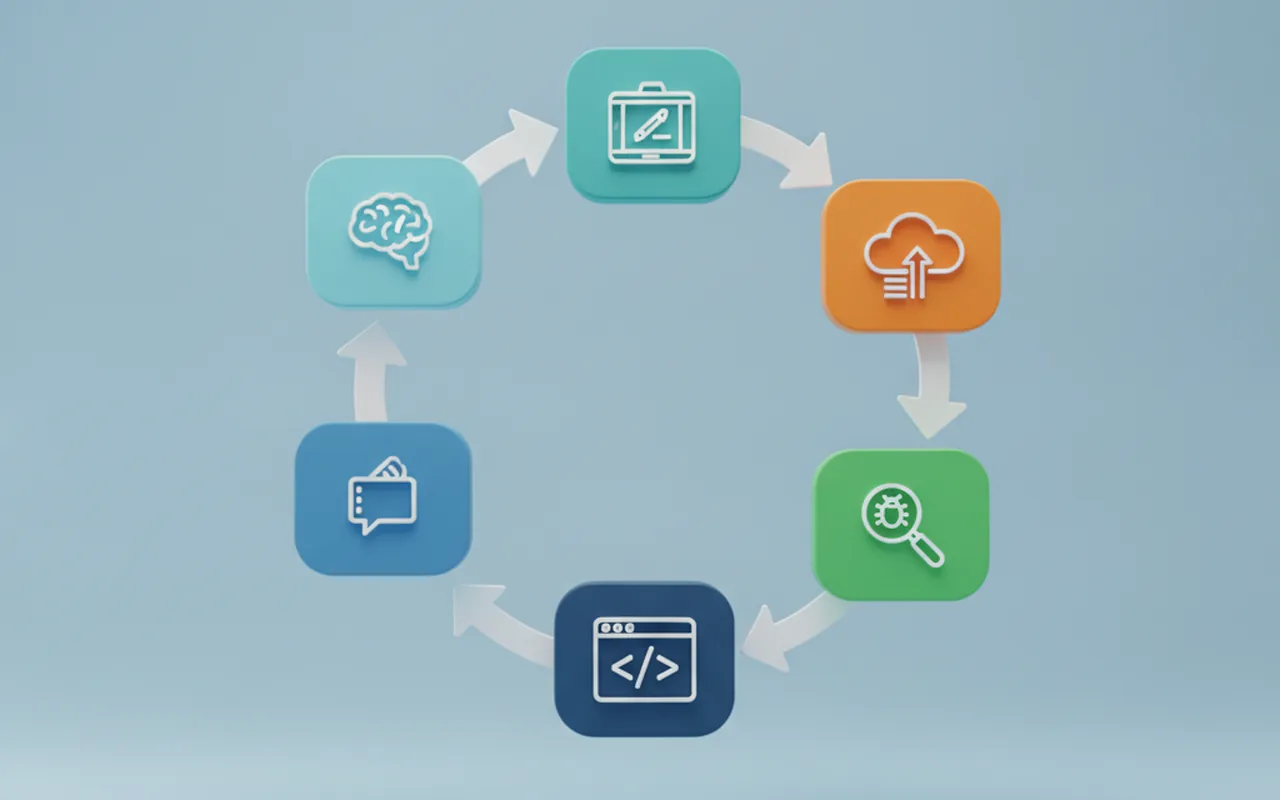
Every serious software project follows a structured process from first idea to ongoing maintenance — and that process has a name: the software development life cycle, or SDLC. Get it right and you get predictable timelines, controlled costs, and software that actually does what users need. Get it wrong and you get scope creep, missed deadlines, and expensive rewrites. What has changed significantly by 2026 is how teams move through these phases: AI-assisted coding, CI/CD pipelines, and shift-left testing have compressed cycle times and redistributed where effort is spent — but the underlying structure remains the map every team navigates by.
What is the software development life cycle (SDLC)?
The software development life cycle (SDLC) is a structured process that defines how software is planned, created, tested, and maintained — transforming a business need into a working, supported product. It provides a repeatable framework that helps teams estimate work, manage risk, allocate resources, and measure progress at each stage. Both AWS and IBM use the SDLC as their canonical reference for how enterprise software projects are organized. The SDLC applies regardless of team size — a two-person startup and a 200-person enterprise product team both pass through the same fundamental phases; what differs is the formality and duration of each one.
The 7 phases of the SDLC
1. Planning & feasibility
Before a single line of code is written, the team defines the project's boundaries. This phase answers four questions: What are we building? Why does it need to exist? Is it technically and financially feasible? Who are the stakeholders? Deliverables include a project charter, initial budget and timeline estimates, resource plan, and a high-level risk register. Poor planning is the single most common source of project failure — scope that seems clear in the kickoff meeting tends to expand dramatically when coding starts if it has not been properly bounded here.
2. Requirements analysis
Requirements analysis translates the business need into a documented specification. Functional requirements describe what the system must do (user authentication, payment processing, report generation). Non-functional requirements define how it must behave (response time under 200ms, 99.9% uptime SLA, GDPR compliance). The output is typically a Software Requirements Specification (SRS) or equivalent artifact — user stories with acceptance criteria in Agile teams — that serves as the contract between stakeholders and the development team. Acceptance criteria defined here become the test cases in phase five.
3. Design
Design converts requirements into a blueprint. System design covers high-level architecture (monolith, microservices, serverless), data model, API contracts, and infrastructure topology. Detailed design addresses individual components: class diagrams, database schemas, UX wireframes and flows, and authentication model. This phase also locks in the technology choices — choosing a web app tech stack here has long-lived consequences, since changing core frameworks mid-build is expensive. Architects should also settle architecture decisions like monolith vs microservices during this phase, not after development begins.
4. Development (implementation)
Development is where the design becomes working software. Engineers follow coding standards, use version control (typically Git with branching conventions like GitFlow or trunk-based development), and break work into discrete units tied to sprint backlogs or issue trackers. In 2026, AI-assisted coding tools are embedded in most professional workflows — studies from JetBrains and GitHub put AI-assisted code suggestions at 30–50% of all accepted completions for experienced developers. The result is faster first drafts of boilerplate and scaffolding; the tradeoff is that senior review of AI output has become a non-optional quality gate, not an optional practice.
5. Testing / QA
Testing validates that the software behaves according to the acceptance criteria defined in phase two. A mature QA process layers several types of testing: unit tests verify individual functions in isolation; integration tests confirm that components interact correctly; end-to-end tests simulate real user flows; user acceptance testing (UAT) lets business stakeholders confirm the system meets their needs. Shift-left testing — writing tests before or alongside code rather than after — has become standard practice because catching defects earlier is dramatically cheaper than finding them in production. Automated test suites running in CI pipelines mean that every code push is now validated against the regression suite in minutes rather than days.
6. Deployment
Deployment moves tested software from a staging environment to production. Modern deployments use CI/CD pipelines to automate the process: a merged pull request triggers a build, runs the test suite, and (in continuous deployment setups) promotes the artifact to production automatically if all gates pass. Staged rollout strategies — blue-green deployments, canary releases, feature flags — limit blast radius if an issue surfaces after release. A defined rollback plan is not optional; the question is not whether production incidents will happen, but how quickly they can be reversed when they do.
7. Maintenance & iteration
Maintenance begins the day software ships and continues for the life of the product. It covers three types of work: corrective (bug fixes), adaptive (updates for OS/dependency changes or regulatory shifts), and perfective (performance improvements, new features driven by user feedback). This phase is where most of a product's lifetime cost lives — industry estimates suggest that maintenance accounts for 60–80% of total software cost over a product's lifespan. Skimping on monitoring, alerting, and documentation during the build phases makes maintenance exponentially more expensive.
SDLC models compared: which one fits your project
The seven phases above describe what needs to happen; the SDLC model describes how teams move through them. Choosing the wrong model for your project type is a common and avoidable mistake.
| Model | Best for | Requirements stability | Risk / compliance fit | Release cadence |
|---|---|---|---|---|
| Waterfall | Fixed-scope builds, regulatory / contractual projects | Fully defined upfront | Strong — audit trail per phase | Single release at end |
| Agile (Scrum / Kanban) | Digital products with evolving requirements | Allowed to change sprint-to-sprint | Moderate — needs lightweight compliance overlays | Every 1–4 weeks |
| Iterative & Incremental | Large systems built and refined over multiple releases | Core stable; periphery evolves | Moderate | Multiple planned releases |
| Spiral | High-risk, complex or novel systems | Uncertain; risk-driven prototyping | High — risk assessed each cycle | Cycles of 3–6 months |
| V-Model | Safety-critical systems (medical, aviation, automotive) | Rigid — no changes after sign-off | Very high — paired test plan for every phase | Single validated release |
| DevOps / Continuous Delivery | Live services requiring rapid iteration and high availability | Continuous refinement | Moderate — compliance gates in CI/CD | Multiple times per day |
Waterfall
Waterfall runs the seven phases in strict linear sequence: each phase must be signed off before the next begins. It works well when requirements are frozen at project start — government contracts, hardware-dependent software, compliance-driven builds with mandated documentation. The major risk is that defects discovered late (in testing or deployment) are expensive to fix because the design and code that caused them have already been approved.
Agile (Scrum / Kanban)
Agile restructures the SDLC into short, repeating cycles (sprints of 1–4 weeks) where a small increment of working software is planned, built, tested, and reviewed. Requirements evolve as the team learns from each iteration. Scrum adds formal roles (Product Owner, Scrum Master) and ceremonies (sprint planning, daily standup, sprint review, retrospective). Kanban limits work in progress without time-boxing sprints. Agile dominates in 2026 for most commercial software products because requirements always change — the model is designed for that reality rather than fighting it.
Iterative & Incremental
Iterative development builds the system in successive passes, each adding functionality and refining what came before. Unlike Agile, the overall scope is usually defined upfront; unlike Waterfall, each phase loops back for refinement. It suits large systems where the architecture is clear but individual modules need to be built and validated progressively.
Spiral
The Spiral model organizes development into risk-driven cycles: each loop identifies the highest-risk unknowns, builds a prototype or proof-of-concept to resolve them, then plans the next cycle. It is the right choice when the technical feasibility or requirements are genuinely uncertain — novel AI integrations, greenfield platform development, or projects where a wrong architectural assumption would be catastrophic to reverse.
V-Model
The V-Model pairs each development phase with a corresponding validation phase: requirements analysis pairs with acceptance testing, system design with system testing, and so on. No coding starts until a complete test plan for every phase exists. This is the standard in safety-critical domains — medical device software, avionics, automotive firmware — where a defect in production carries physical risk and regulatory penalties.
DevOps / continuous delivery
DevOps dissolves the traditional boundary between development and operations. Developers write code that is automatically tested, packaged, and deployed through a pipeline — sometimes dozens of times per day in mature teams. The DORA Research program identifies elite DevOps teams as those deploying on demand with a change failure rate below 5% and a recovery time under one hour. This model suits live digital services where user-facing impact from delayed releases is significant.
How to choose the right SDLC model
Most projects fail at model selection not because the options are obscure, but because teams default to what they know rather than what fits. Work through these five decision points:
- Requirements clarity. Are your requirements fully defined, partially defined, or actively unknown? Fully defined points toward Waterfall or V-Model. Partially defined fits Agile or Iterative. Genuinely unknown warrants Spiral or a discovery sprint before committing to any model.
- Risk and compliance profile. Does your domain have regulatory requirements for documented testing and phase sign-offs (FDA, FAA, automotive safety standards)? V-Model or Waterfall with formal review gates. Commercial software with no hard regulatory constraints can use Agile or DevOps.
- Team size and distribution. Agile works best with co-located or near-timezone teams of 5–15. Distributed teams across many time zones benefit from more formal documentation disciplines, which push toward Iterative or hybrid Waterfall-gate / Agile-execution models.
- Release cadence expectations. Does your business need to ship continuously, or is there a fixed delivery date? Continuous product iteration → Agile or DevOps. Fixed contract delivery → Waterfall or Iterative with defined milestones.
- Budget model. Fixed-price contracts require locked scope, which requires Waterfall or V-Model. Time-and-materials engagements are a natural fit for Agile, where scope evolves as the team learns.
How the SDLC works in 2026
The phases have not changed, but what happens inside them has shifted substantially:
- AI-assisted development. Code generation tools (GitHub Copilot, Cursor, Claude Code, and others) now contribute to 30–50% of accepted completions in professional codebases. The effect is faster implementation and test scaffolding — but also a higher burden on code review and a growing need to validate AI-generated logic for correctness and security.
- Shift-left security (DevSecOps). Security is no longer a phase-six or phase-seven concern. SAST scanners, dependency vulnerability checks, and secret detection tools run in CI pipelines as part of every commit, making security a continuous rather than terminal activity.
- Low-code and citizen developers. Platforms like Retool, Bubble, and internal tooling suites let non-engineers build functional applications for internal workflows. This does not eliminate the SDLC for complex products, but it has moved some simpler builds outside the traditional development process.
- Hybrid models dominate. In practice, most mature engineering organizations run a hybrid: Waterfall-style gates for major releases (fixed scope, formal sign-off) with Agile-style execution inside each phase (sprint-based delivery, continuous integration). The boundary is not as sharp as the textbook models suggest.
SDLC in a custom software project
For a founder or product owner commissioning a custom build, the SDLC is not just an internal engineering process — it is the structure that determines how your project will be scoped, priced, and delivered. Understanding it before entering a vendor conversation is a concrete advantage.
The planning and requirements phases are where you have the most leverage. A founder who arrives at a development partner with a clear SRS, defined acceptance criteria, and a prioritized backlog will receive a more accurate estimate and a more manageable contract than one who arrives with a sketch on a napkin. Starting with building an MVP — scoping the build to a single core user flow — is the most reliable way to move from requirements to a validated product without overbuilding in the design and implementation phases.
When evaluating partners, ask specifically how they manage each SDLC phase: What is their requirements process? How do they handle change requests mid-sprint? What does their CI/CD pipeline look like? What is their rollback plan for production deployments? These questions are direct proxies for delivery maturity — and choosing a software development company with demonstrable process in each phase is more predictive of success than portfolio size or hourly rate.
For projects that need to move from idea to production without picking up technical debt along the way, partnering with a custom software development team that applies a structured SDLC from day one — with defined phases, CI/CD, and handover documentation — is considerably cheaper than retrofitting process after launch.
FAQ
What are the 7 phases of the SDLC?
The seven phases are: (1) planning and feasibility, (2) requirements analysis, (3) design, (4) development (implementation), (5) testing and QA, (6) deployment, and (7) maintenance and iteration.
What is the difference between SDLC and Agile?
The SDLC is the overall framework — the set of phases every software project passes through from idea to maintenance. Agile is one methodology for moving through those phases: iteratively, in short sprints, with frequent stakeholder feedback. You can run the SDLC in a Waterfall style (phases in strict sequence) or an Agile style (phases repeated in short cycles) — Agile is a way of executing the SDLC, not a replacement for it.
Which SDLC model is most used in 2026?
Agile and Agile/DevOps hybrids dominate in commercial software development. Waterfall remains the standard for fixed-scope contracts, government projects, and heavily regulated domains. V-Model is the norm in safety-critical industries (medical, automotive, avionics). Most mature organizations use a hybrid: Agile execution with Waterfall-style phase gates for major milestones.
How long does the SDLC take?
It varies from weeks for a focused MVP to many months for a complex enterprise platform. A simple SaaS feature might move through all phases in a single two-week sprint. A new banking system might take 18–24 months from planning to production. Maintenance is ongoing for the entire life of the product — it does not end at launch.
Why is the maintenance phase important?
Most of a software product's total cost and value accrue after launch, not before it. Industry benchmarks suggest maintenance accounts for 60–80% of total lifetime software cost. Security vulnerabilities must be patched, dependencies updated, and features refined based on real user behavior. Products that are not actively maintained become insecure, fall behind regulatory requirements, and lose users — maintenance is not a cost center, it is a product strategy.