What Is DevOps? A Business Owner’s Plain-English Guide

Your development team ships an update. Something breaks in production. The developers say it was an infrastructure problem. The operations team says the code was untested. Meanwhile, your customers are experiencing errors and your support queue is growing. If that scenario sounds familiar, you have witnessed the classic symptom of a siloed software organization — and DevOps is the solution the industry converged on over the past fifteen years.
DevOps is not a tool or a job title. It is a combination of culture, practices, and automation that brings the people who build software and the people who run it into a single, accountable team. This guide explains what that means in plain English, what it delivers for your business, and what to ask your development team to find out whether they are actually doing it.
DevOps does not replace your software development life cycle — it accelerates it.
What DevOps Actually Means (No Tech Jargon)
The word DevOps is a portmanteau of Dev (software development) and Ops (IT operations). The term was coined around 2009 by Patrick Debois, a Belgian consultant who organized the first DevOpsDays conference after growing frustrated watching development and operations teams work against each other instead of together. The name stuck because the problem it described was universal.
According to IBM’s DevOps definition, DevOps is an approach that combines software development and IT operations to shorten the software delivery cycle and provide continuous delivery of high-quality software. In practice, this means breaking down the wall between the team that writes code and the team that deploys and operates it — giving both groups shared responsibility for the end result: software that works reliably in production.
DevOps vs. Traditional Software Development
The contrast with traditional software delivery is stark. In a traditional setup, development and operations sit in separate departments with separate priorities. Developers optimize for shipping features; operations optimizes for stability. Every release is a negotiation, a handoff, and a risk event.
| Dimension | Traditional (Siloed) | DevOps |
|---|---|---|
| Team structure | Dev and Ops in separate departments | Dev and Ops share ownership end-to-end |
| Release cadence | Monthly or quarterly deploys | Multiple deploys per day |
| Handoffs | Manual, documented, slow | Automated pipelines with no handoff friction |
| Incident response | Blame-focused; long resolution times | Blameless postmortems; fast recovery |
| Infrastructure | Manually configured servers | Infrastructure as code, version-controlled |
| Feedback loops | Bugs found weeks after they are written | Automated tests catch issues within minutes |
The Three Pillars of DevOps
DevOps rests on three interconnected pillars. Remove any one of them and the approach breaks down.
Culture — Breaking Down the Dev vs. Ops Wall
Culture is the hardest pillar and the most important. In a DevOps organization, developers share responsibility for uptime and production reliability — they are on-call for their own code. Operations engineers share responsibility for code quality — they contribute to deployment pipelines rather than gating releases. When something goes wrong, the team runs a blameless postmortem: a structured review of what happened and why the system allowed it, without assigning personal fault. The goal is to fix the process, not punish the person.
This cultural shift is why DevOps implementations often take 6–18 months to feel real. Changing tools is fast; changing how people think about ownership is slow.
Automation — Eliminating Slow, Error-Prone Manual Work
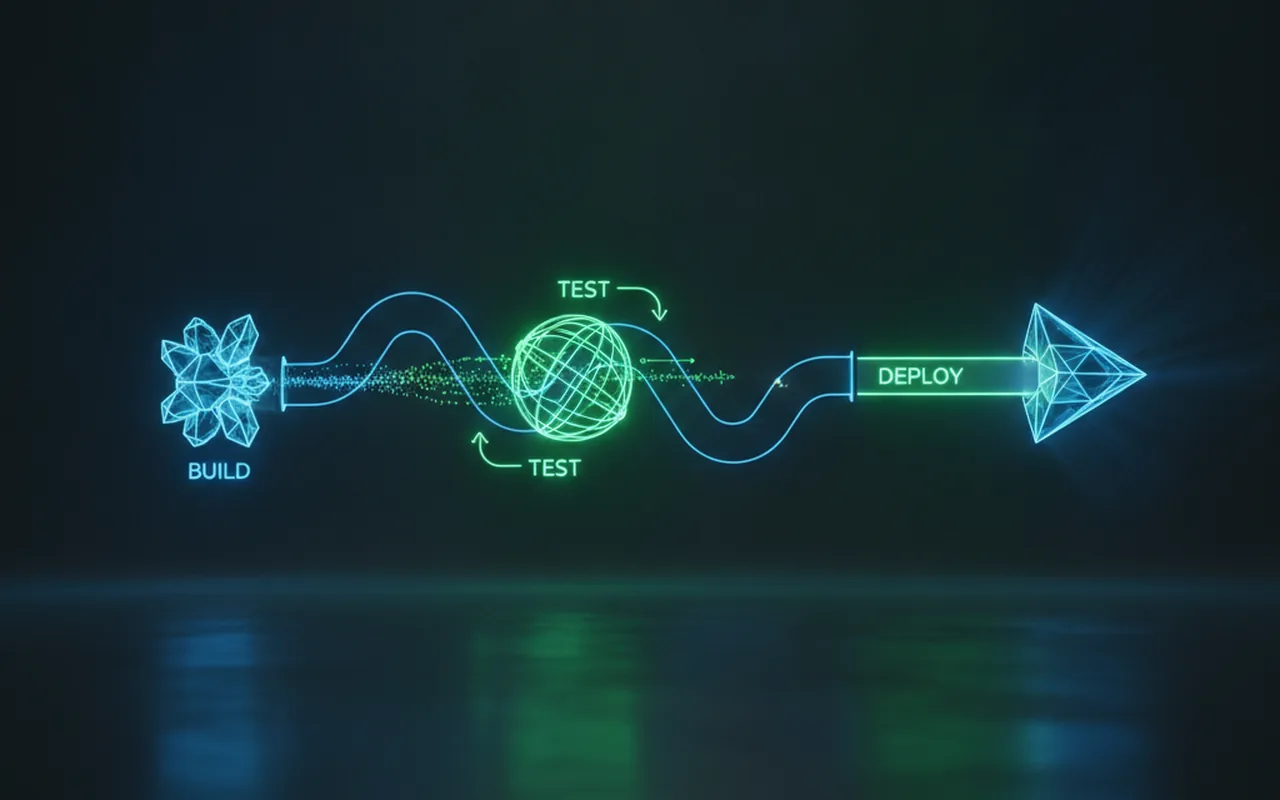
Every manual step in a software release is a place where things can go wrong and a place where a human wastes time. DevOps automates testing, building, and deploying software through continuous integration and continuous delivery (CI/CD) pipelines. A developer pushes code; automated tests run immediately; if they pass, the build is packaged and can be deployed with a single command or automatically. Learn more about how this works in our detailed guide to CI/CD pipelines.
Automation does not eliminate human judgment — it removes the tedious, repeatable steps so engineers can spend their time on problems that actually require thinking.
Measurement — Knowing What “Good” Looks Like
You cannot improve what you do not measure. DevOps teams track four standard metrics, defined by the DORA State of DevOps Report, which has tracked engineering performance across thousands of organizations for over a decade:
- Deployment Frequency — How often do you release to production? (Daily is good; multiple times per day is elite.)
- Lead Time for Changes — How long from a commit to running in production? (Hours is good; days is acceptable; weeks is a warning sign.)
- Change Failure Rate — What percentage of releases cause a production incident? (Under 15% is the target for high performers.)
- Mean Time to Recovery (MTTR) — When something breaks, how quickly is it fixed? (Under one hour is elite; over a day is a risk to your business.)
Core DevOps Practices Your Development Team Should Use
You do not need to understand every tool in the DevOps ecosystem, but knowing the names of the key practices helps you ask the right questions when evaluating a vendor or reviewing your internal team’s process.
Continuous Integration (CI)
Every developer on the team merges their code into a shared branch at least once per day. Each merge triggers an automated suite of tests that verifies the new code does not break anything. Issues are caught within minutes, when they are cheapest to fix, rather than days later when multiple changes have been stacked on top of each other. This is what CI/CD pipelines automate — learn more in our detailed CI/CD guide.
Continuous Delivery / Deployment (CD)
Continuous Delivery means every build that passes automated tests is ready to be released to production at any time — deploying requires a human to press a button. Continuous Deployment goes one step further: every passing build is automatically released without human intervention. Most mature teams operate somewhere between the two, with automated deployment to staging and a manual gate for production.
Infrastructure as Code (IaC)
Servers, networks, and databases are defined in version-controlled configuration files rather than configured by hand. Tools like Terraform and Ansible let teams provision identical environments every time, eliminating the “it works on my machine” class of production incidents. When a new developer joins, they can spin up a complete local environment in minutes instead of following a 40-page setup guide.
Monitoring and Observability
DevOps teams instrument their applications with real-time dashboards, alerting, and error tracking from the first day in production. You know about problems before your customers do — and often before they affect anyone. Observability is what lets a team recover in minutes rather than hours: when an alert fires, engineers already have the data they need to diagnose the cause.
What DevOps Delivers for Your Business (The ROI Case)
The DORA research program has surveyed tens of thousands of engineering teams worldwide for over a decade. The performance gap between elite DevOps organizations and low performers is not incremental — it is orders of magnitude. Elite DevOps teams deploy 973× more frequently and recover from incidents 6,570× faster than low-performing teams.
What that means in business terms:
| Business Goal | DevOps Practice | Business Outcome |
|---|---|---|
| Faster time to market | CI/CD pipelines, small frequent releases | Features reach customers in days, not months |
| Fewer costly outages | Automated testing, monitoring, IaC | Defects caught pre-production; MTTR under an hour |
| Predictable delivery | DORA metric tracking | Engineering performance is measurable and improvable |
| Lower rework cost | Continuous integration catches bugs fast | Defects fixed when code is fresh, not weeks later |
| Happier customers | Blameless postmortems, fast recovery | Incidents resolved before most users notice |
DevOps vs. Agile — Not the Same Thing
A common point of confusion: DevOps and Agile are frequently mentioned together, but they address different problems. Agile is a philosophy and set of frameworks — Scrum, Kanban, and others — that govern how you plan and prioritize work. It deals with backlogs, sprints, daily standups, and sprint reviews. DevOps governs how you build, test, and deploy that work once it is planned. They are complementary, not competing — most teams that do DevOps well also use an Agile framework to manage their roadmap. For a breakdown of the planning side, see our guide to Agile vs. Scrum vs. Kanban.
7 Questions to Ask Your Development Team About DevOps
Whether you are evaluating a new vendor or reviewing the practices of your existing team, these questions cut through vague assurances and surface what is actually happening in the delivery pipeline.
- How often do you deploy to production? — Elite teams deploy multiple times per day. Monthly or less is a red flag.
- How long does it take to fix a critical bug and push it live? — The answer reveals both engineering speed and deployment automation maturity.
- Do you have automated test coverage? What percentage? — Coverage below 60% on critical paths means manual testing is a bottleneck.
- How do you handle infrastructure — is it version-controlled? — Teams using IaC can rebuild environments reproducibly; those who are not are one config drift away from an incident.
- What does your incident response process look like? — Look for on-call rotations, runbooks, and blameless postmortems — not just “we fix things when they break.”
- Can you show me a deployment frequency dashboard from a recent project? — Any team tracking DORA metrics can produce this in minutes. If they cannot, they are not measuring.
- What is your Change Failure Rate target? — Teams that track this number take release quality seriously. Teams that have never heard of it probably do not.
When hiring a vendor, our guide on how to choose a software development company covers the full vetting checklist in detail.
Or if you are looking for a team that already has DevOps built into their process, a custom software development partner like YuSMP Group can walk you through their CI/CD setup, deployment frequency, and incident response process before you sign anything.
How to Get Started with DevOps (If You Are Building a Team)
If your organization is starting from zero, the right approach is phased rather than all-at-once. Trying to change culture, tooling, and process simultaneously is the most common reason DevOps initiatives stall.
- Audit your current release process. Map every manual step from “code complete” to “live in production.” Count the handoffs, the waiting time, and the failure points. This baseline is your benchmark and your argument for change.
- Hire or upskill for DevOps culture, not just tools. DevOps is a mindset shift before it is a toolchain. Engineers who understand shared ownership and blameless postmortems are more valuable than engineers who know every Terraform command.
- Automate your test and deploy pipeline first. CI/CD has the highest ROI of any DevOps investment. Even a basic pipeline that runs tests automatically on every commit and deploys to staging without manual intervention changes the team’s feedback loop dramatically.
- Instrument monitoring from day one. You cannot improve what you cannot see. Set up error tracking, latency dashboards, and alerting before your first real users arrive, not after your first outage.
Frequently Asked Questions About DevOps
Is DevOps only for large companies?
No. DevOps practices — automated testing, small frequent deployments, shared ownership — benefit teams of any size. Many startups adopt DevOps from day one precisely because it reduces the cost of defects and accelerates time to market without requiring a large engineering org. The cultural shift is arguably easier at small scale, where everyone already wears multiple hats and there are no entrenched departmental walls to break down.
How long does it take to implement DevOps?
There is no single timeline. Cultural change is the hardest part and can take 6–18 months to genuinely stick. Tooling — CI/CD pipelines, infrastructure as code — can be implemented in weeks. A phased approach starting with automated testing and deployment pipelines typically shows measurable ROI within the first quarter, giving you the data to justify the broader cultural and process investments that follow.
Does DevOps mean I need a dedicated DevOps engineer?
Not necessarily. On smaller teams, a senior full-stack engineer with DevOps skills can own the pipeline alongside their other responsibilities. Dedicated DevOps or platform engineers become genuinely valuable once the team scales past 8–10 engineers or manages complex multi-service infrastructure where the pipeline itself has become a product worth specializing in.
What is the difference between DevOps and SRE?
DevOps is a philosophy and set of practices for unifying software development and IT operations. SRE — Site Reliability Engineering, pioneered by Google — is a specific, opinionated implementation of DevOps ideas with formal reliability targets: service-level objectives (SLOs), error budgets, and strict on-call engineering standards. SRE is DevOps with stricter engineering rigor around uptime. For most companies below a few hundred engineers, DevOps principles applied pragmatically will deliver far more than a formal SRE program.