How to Write a Software Requirements Document (SRS)
A software requirements document — formally a Software Requirements Specification, or SRS — is the shared source of truth that turns a vague idea into a buildable, testable scope. It tells everyone on the project: developers, designers, testers, stakeholders, and the vendor you hire — exactly what the system must do, how it must perform, and what "done" looks like. Skipping it might feel like saving a week at the start, but it is usually where budgets quietly overrun and timelines invisibly collapse. Get it right first, and you cut rework, scope creep, and the cost of late surprises.
What is a software requirements document (SRS)?
An SRS is a structured document that captures the complete set of requirements for a software system: what it must do, the constraints it must operate within, and the criteria by which it will be judged complete. It is not the same as a product brief (which describes the problem and the market opportunity), a Business Requirements Document or BRD (which focuses on business goals and ROI), or a collection of user stories (which are informal, conversation-sized slices of functionality). An SRS is more formal and more complete than any of those — it bridges the gap between a business idea and a development team's sprint backlog.
Typically the document is drafted collaboratively by a product owner or business analyst, reviewed by the lead engineer, and formally signed off by key stakeholders before development begins. It does not need to be hundreds of pages — a well-scoped SRS for a focused product can be 10–20 pages — but every section it covers must be specific enough for a developer to implement from it and a tester to write test cases against it.
Why an SRS is worth the effort
Organizations that skip formal requirements documentation consistently report the same set of downstream problems: cost overruns, late deliveries, and a finished product that does not match what the client expected. A solid SRS prevents most of those by:
- Aligning stakeholders before coding starts. Every disagreement about scope is far cheaper to resolve in a document than in a sprint review six weeks in.
- Enabling accurate estimates and quotes. Developers cannot price uncertain work. A clear SRS turns a vague brief into a concrete scope that a team can estimate with confidence — and forms the basis of any fixed-price or time-and-materials contract.
- Removing decision fatigue during development. When a developer hits an edge case at 11 pm, the SRS gives them the answer instead of blocking on a stakeholder email thread.
- Providing the foundation for test cases and acceptance criteria. Every requirement in the SRS maps directly to something a QA engineer can verify — which means fewer "that's not what I meant" conversations at delivery.
- Reducing change-order friction. When a new request arrives mid-build, the SRS makes it clear whether it is a clarification of an existing requirement or a scope expansion that warrants a budget discussion.
Functional vs non-functional requirements
Every SRS divides its requirements into two broad categories. Understanding the difference is essential before you start writing, because they are documented differently, tested differently, and get missed in different ways.
Functional requirements
Functional requirements describe what the system does — the specific behaviors, features, user flows, business rules, and data transformations a user can trigger or observe. They answer: "What should happen when a user does X?" Examples:
- A registered user can log in with email and password; after three failed attempts, the account is locked for 15 minutes.
- The checkout flow calculates shipping costs in real time by calling the carrier API; if the API is unavailable, the system displays a flat-rate fallback and logs the incident.
- An admin can generate a PDF invoice for any completed order; the invoice includes order line items, tax breakdown, and the company logo.
Each functional requirement should be testable on its own. If you cannot write a clear pass/fail test case for it, it is not specific enough.
Non-functional requirements
Non-functional requirements describe how well the system performs — the quality attributes that cut across features rather than describing any single one. They answer: "At what level must the system operate?" Examples:
- Performance: The product listing page must load in under 2 seconds for 95% of requests under a load of 500 concurrent users.
- Security: All user passwords must be hashed with bcrypt (minimum cost factor 12); PII in transit must use TLS 1.2 or higher.
- Accessibility: The web interface must conform to WCAG 2.1 Level AA.
- Availability: The API must maintain 99.9% uptime measured monthly.
Non-functional requirements are frequently the ones that get omitted in informal specs, and they are correspondingly the ones that cause the loudest surprises when the first load test runs.
| Aspect | Functional requirements | Non-functional requirements |
|---|---|---|
| Question answered | What the system does | How well it does it |
| Examples | Login, checkout, generate invoice | Load <2s, 99.9% uptime, WCAG AA |
| How tested | Feature / acceptance tests | Load, security, usability testing |
| If missing | Features get built wrong | System is slow, insecure, or unusable |
The structure of a good SRS (section by section)
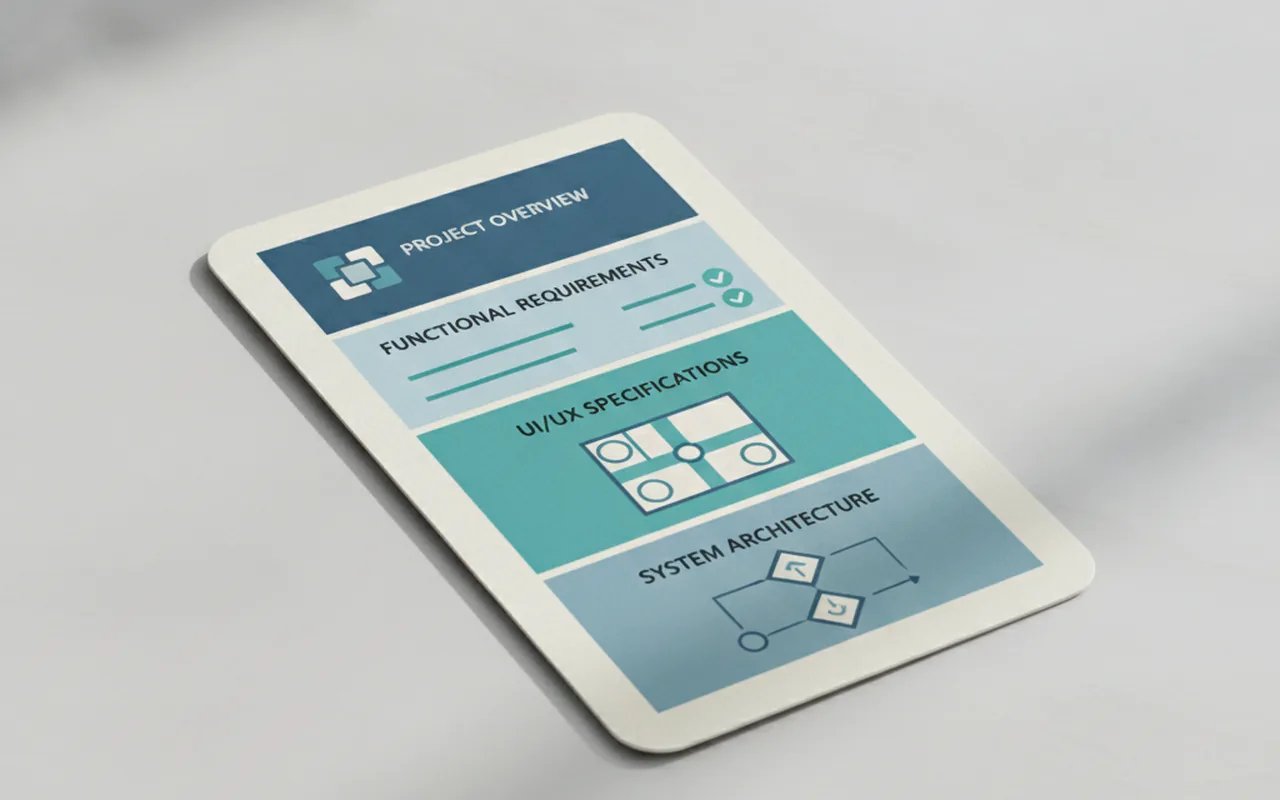
There is no single mandatory template, but the most widely used structures follow the guidance of IEEE 830 and its successor ISO/IEC/IEEE 29148, which define a standard for SRS content and organization. A well-structured document typically includes:
- Introduction and purpose. What the document covers, who the intended audience is, and the conventions used throughout (abbreviations, definitions).
- Overall description — scope and context. What the product is, who its users are, how it fits into a broader ecosystem, and what is explicitly out of scope.
- Functional requirements. The numbered list of specific behaviors the system must support. Each requirement has a unique ID so it can be traced through design, development, and testing.
- Non-functional requirements. Performance, security, scalability, reliability, accessibility, compliance. Where possible, quantified ("respond in under 500ms at P95").
- External interfaces. How the system interacts with the outside world — UI specifications, third-party APIs and services, hardware integrations, data formats for imports/exports.
- Data requirements. What data the system stores, how long it is retained, ownership, privacy classification, and backup/recovery expectations.
- Constraints and assumptions. Technology constraints (a client already has a specific cloud provider), regulatory requirements, assumptions the team is taking as given (e.g., "users have a modern browser").
- Acceptance criteria. The explicit conditions under which the client or product owner will sign off on a feature or the system as a whole. This is the SRS's bridge to UAT.
- Appendix and glossary. Domain-specific terms, data dictionaries, reference documents, and any diagrams (data-flow, entity-relationship) that support the main text.
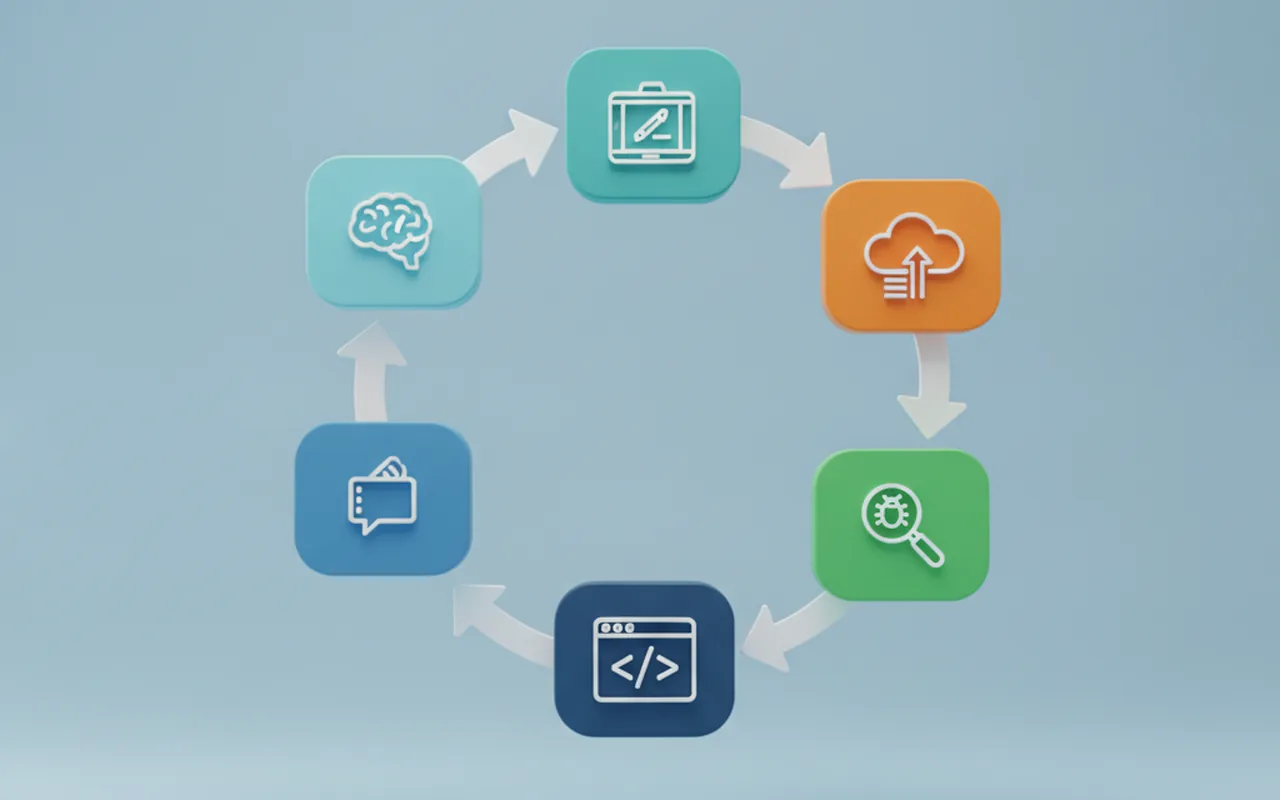
Understanding where requirements fit in the software development life cycle helps teams decide how detailed each section needs to be at different project stages. A waterfall project pins down the SRS before any code is written; a phased delivery may produce a high-level SRS upfront and refine requirements section-by-section as each release approaches.
How to prioritize requirements (MoSCoW)
Not every requirement carries equal weight, and treating them as if they do is one of the fastest routes to scope creep. The MoSCoW method — Must, Should, Could, Won't (this release) — is a lightweight but powerful prioritization framework that belongs in every SRS.
- Must have — non-negotiable. The system cannot launch without these. If a Must is cut, the release fails its core purpose.
- Should have — high value but not launch-critical. These ship if time allows and are strong candidates for the next iteration.
- Could have — nice to include. Cut these first when estimates run long.
- Won't have this release — explicitly parked. Documenting these prevents them from creeping back in as "quick additions."
A worked example: for an e-commerce checkout, user registration (Must), saved payment methods (Should), one-click reorder (Could), and cryptocurrency payment (Won't — v1). Forcing a conversation about each requirement's tier surfaces disagreements early, keeps the release scope realistic, and gives the team a clear basis for saying "that's a Should, not a Must" when a stakeholder pushes for a feature in week eight.
MoSCoW also connects directly to scoping an MVP: Musts define the minimum viable product, while the Should and Could lists become the first post-launch roadmap.
Common mistakes to avoid
- Vague, untestable requirements. "The app should be fast" and "the interface should be user-friendly" cannot be tested and will be interpreted differently by every person who reads them. Always quantify.
- Mixing solution with requirement. "The login form must use OAuth 2.0" describes a solution. "The system must support single sign-on via an organization's existing identity provider" describes a requirement. Leave implementation choices to the architecture phase unless there is a genuine business or compliance reason to constrain them.
- Missing acceptance criteria. A requirement without a clear pass/fail criterion is incomplete. The developer does not know when they are done, and the client does not know what to sign off on.
- No versioning or sign-off process. Requirements change. Without a version history and a formal sign-off step, there is no way to distinguish an approved change from an undiscussed one — which makes every scope dispute a he-said-she-said argument.
- Gold-plating. Adding undocumented features because they "seem like a good idea" violates the SRS as much as scope creep does. Everything built should trace back to a documented, prioritized requirement.
A reusable SRS template outline
Use this condensed structure as a starting point for your own document. Copy it, adapt the section headings to your project's vocabulary, and fill in each section before handing the brief to a developer.
- Document header — title, version, date, authors, approvers
- Introduction — purpose, scope, definitions, audience
- Product overview — system context diagram, user roles, key use cases
- Functional requirements — numbered list (FR-001, FR-002…) with MoSCoW tag and acceptance criterion per item
- Non-functional requirements — performance targets, security standards, accessibility level, compliance obligations
- External interface requirements — UI mockup references, API contracts, hardware or third-party integrations
- Data requirements — entities, retention periods, privacy classification
- Constraints and assumptions — platform, budget, timeline, regulatory
- Acceptance criteria — overall system sign-off conditions, UAT process
- Appendix — glossary, data dictionary, reference diagrams, change log
A well-written SRS is typically the first real deliverable of any serious build — and handing it to a custom software development team alongside your brief dramatically shortens the discovery phase and prevents the misunderstandings that drive change orders. If you have not yet chosen how to engage a team, the companion question of how to choose a software development company will help you evaluate vendors with the right criteria.
Frequently asked questions
What is the difference between an SRS and a PRD?
A Product Requirements Document (PRD) typically describes the problem, the market opportunity, and the high-level product goals in business language — it answers "why build this and for whom." A Software Requirements Specification goes deeper: it translates those goals into precise, testable requirements — features, behaviors, performance standards, and acceptance criteria — that a development team can build and a QA team can verify. In practice, many teams produce both: a PRD for stakeholder alignment and an SRS as the technical contract that governs the build.
How long does it take to write an SRS?
For a focused product with a clear scope, a first-draft SRS can take a skilled business analyst or product owner one to two weeks, including stakeholder interviews and review cycles. Complex enterprise systems with many integrations and compliance constraints can take four to eight weeks. The time is almost always recovered in the development phase: teams with a complete SRS spend significantly less time in back-and-forth clarification and rework than those working from informal briefs.
Who owns the software requirements document?
Ownership typically sits with the product owner or business analyst on the client side, with input from the lead developer or solutions architect on the vendor side. The key is that a named person is responsible for resolving ambiguities, approving changes, and maintaining version history. A document without a clear owner tends to drift — requirements get added informally, sign-off is skipped, and the document loses its authority as a source of truth.
Do agile teams need an SRS?
Agile teams do not always produce a traditional SRS, but the underlying work — requirements elicitation, prioritization, acceptance criteria — still happens; it is just distributed across sprint planning and backlog refinement rather than front-loaded into a document. For projects with a fixed-price contract, a regulated industry, or a handoff to a third-party vendor, a more formal SRS (or a "lightweight SRS" that covers scope, non-functional requirements, and interfaces without full waterfall detail) is usually worth the investment even in an agile context.
What happens if requirements change after the SRS is signed off?
Changes after sign-off should go through a formal change-request process: document the new requirement, assess its impact on scope and cost, get written approval from the relevant stakeholders, and update the SRS with a version note. This is not bureaucracy for its own sake — it is the mechanism that keeps "quick additions" from quietly doubling the project scope. Most well-run contracts include a change-order clause for exactly this reason; your choice of contract model determines whether change-order friction works for or against you.