How to Build an MVP: A Practical Guide for 2026
Most first products fail for the same quiet reason: the team built too much before finding out whether anyone wanted it. A minimum viable product — an MVP — exists to solve exactly that problem. It is the smallest version of your idea that a real user can use to get real value, shipped fast enough that you learn the truth before you spend the budget.
The phrase gets misused constantly. An MVP is not a broken, half-finished app you are embarrassed by, and it is not "version one with fewer features." It is a deliberate experiment: the leanest thing that tests your single riskiest assumption. This guide walks through what an MVP really is, how to scope one without gutting its value, the build options open to you in 2026, and how to read the results so you know whether to double down, pivot or walk away.
What an MVP actually is (and isn't)
The classic definition comes from lean startup thinking: an MVP is the version of a new product that lets a team collect the maximum amount of validated learning about customers with the least effort. Every word there earns its place. Validated learning means facts from real usage, not opinions from a survey. Least effort means you are optimising for speed of insight, not completeness of feature set.
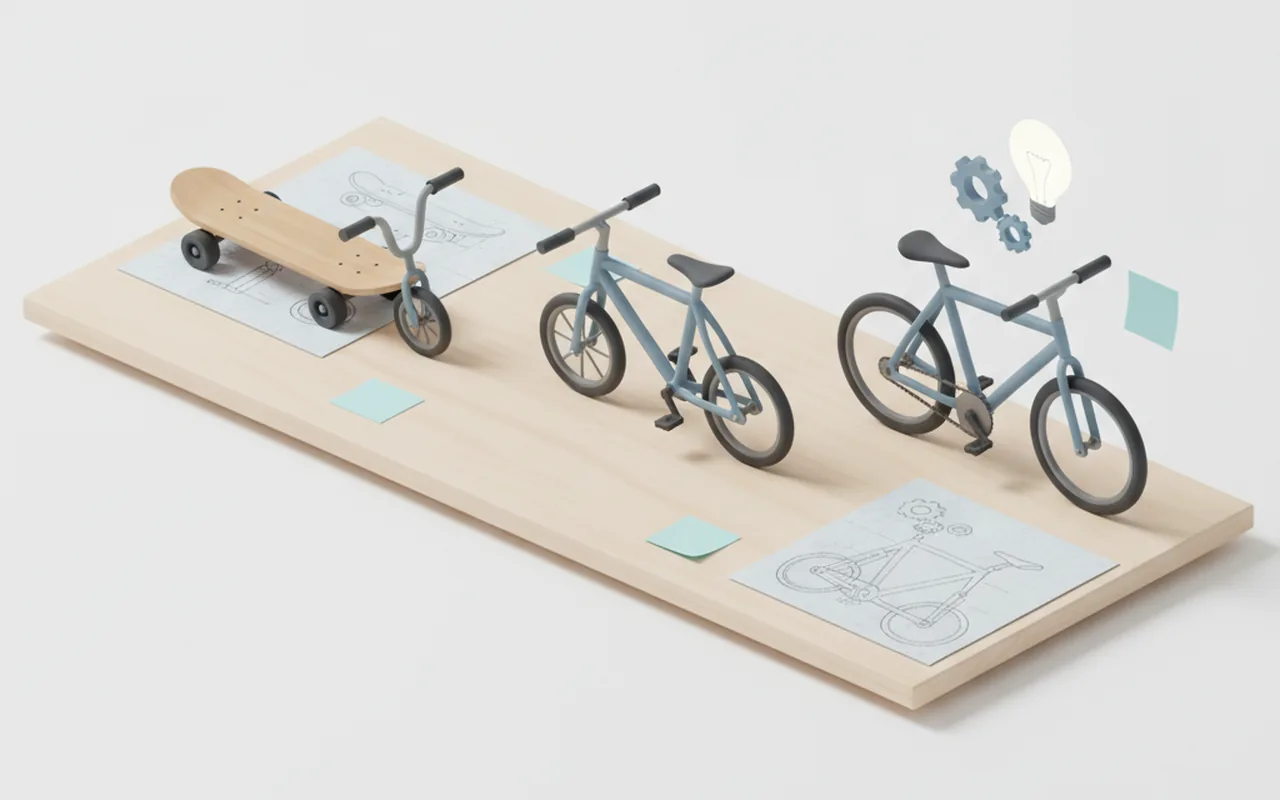
The famous "skateboard, then bicycle, then car" sketch captures the spirit better than any spec. You do not ship one wheel of a car and ask users to imagine the rest. You ship a skateboard — something whole and usable that solves the core job of "get me from A to B" — and then improve toward the car as you learn what riders actually need. The MVP is complete for its purpose, just small in scope. When the core job depends on bespoke logic rather than off-the-shelf tooling, it can help to scope that first build with this studio before committing to a full roadmap.
What an MVP is not:
- Not a prototype. A prototype tests whether something can be built or how it looks; an MVP is a live product real users pay for, sign up for, or return to.
- Not a proof of concept. A PoC answers a technical question in a lab. An MVP answers a market question in the wild.
- Not "cheap and shoddy." The one flow your MVP does, it must do well. Minimum scope, not minimum quality.
Step 1: Define the one problem you're testing
Before any design or code, write a single sentence: "[Specific user] struggles to [specific job], and I believe they will [pay / sign up / return] if I help them [specific outcome]." That sentence is your hypothesis, and the entire MVP exists to prove or disprove it.
The discipline here is ruthless specificity. "Small business owners want better marketing" is not testable. "Solo e-commerce sellers waste an hour a day rewriting product descriptions and will pay $19/month for a tool that drafts them" is. The tighter the sentence, the easier every later decision becomes, because you can hold each proposed feature against it and ask: does this help test the hypothesis, or is it just nice to have?
Step 2: Find your core flow — and cut everything else
Every product idea is really a bundle of features. An MVP is the discipline of finding the one path through that bundle that delivers the core value, and deleting the rest — for now. A useful exercise: list every feature you imagine, then sort them into three buckets.
| Bucket | Definition | Goes in the MVP? |
|---|---|---|
| Core | Without it, the product delivers zero value | Yes — this is the whole MVP |
| Expected | Users assume it exists (e.g. password reset) | Only the bare minimum needed to use the core |
| Delight | Nice extras, polish, "wouldn't it be cool if…" | No — this is your roadmap, not your MVP |
Be honest, because everyone underestimates how much sits in the "expected" and "delight" buckets. A common failure is treating settings pages, admin dashboards, onboarding tours, integrations and multiple pricing tiers as launch requirements. For a first test they almost never are. If a feature does not directly demonstrate that your hypothesis is true, it waits.
Map the shortest possible route a user takes from arriving to getting the "aha" moment your product promises. That route — often three to five screens — is your build target. Everything off that path is scope you can defer.
Step 3: Choose how to build it
In 2026 you have more ways to ship an MVP than ever, and picking the lightest one that will hold is part of the skill. The right answer depends on how much you need to test the technology versus the demand.
No-code and low-code
If your risk is "will anyone want this," not "can this be built," no-code tools let you assemble a working product in days without engineers. Website builders, form-and-database tools and workflow automators can back a surprising range of MVPs. It is the fastest path to a live experiment, at the cost of hitting a ceiling once you need custom logic or scale.
The "concierge" or manual MVP
Sometimes the smartest MVP has almost no software at all. You deliver the promised outcome by hand behind a simple front end — a landing page and a human doing the work in the background — to prove people will pay before you automate anything. If you cannot deliver the value manually for ten customers, no amount of code will save the idea.
Custom-built
When the product is the technology — a genuinely novel algorithm, real-time processing, tight performance needs — you build. Keep the stack boring and familiar so you move fast; this is not the moment to learn a new framework. Our guide to choosing a web app tech stack in 2026 walks through picking pragmatically, and if mobile is central, weigh native versus cross-platform development before you commit. AI coding assistants have also changed the economics of a custom MVP — a small team now ships far more per week than it could two years ago, as our look at AI coding tools in 2026 details.
A quick way to choose:
- Testing demand only? No-code or a concierge MVP.
- Testing a workflow with some custom logic? Low-code, or a thin custom build.
- The technology itself is the bet? Custom, with the leanest viable stack.
Step 4: Set the bar for "done"
An MVP still needs a definition of done, or scope creep will quietly turn it back into the full product. Write down, before you build, the exact core flow that must work and the quality bar it must clear. "A user can sign up, create one project, and share it with one collaborator, with no data loss and pages loading under two seconds" is a done line you can hold to. Anything not on that line is out of this release by definition.
Pay special attention to the seams users judge you on even in a minimal product: sign-up that works, data that does not disappear, and a first-run experience that does not strand people. You can skip almost anything except the parts that make the core feel trustworthy.
Step 5: Instrument it before you launch
An MVP you cannot measure is just a small product — you have spent effort but bought no learning. Decide up front what a "yes" looks like and wire in the tracking to see it. That means picking one or two success metrics tied to your hypothesis, not a wall of vanity numbers.
If your hypothesis is about retention, track how many users come back in week two. If it is about willingness to pay, track how many hit the paywall and convert. Set a rough threshold in advance — "I will consider this validated if 30% of sign-ups complete the core flow twice" — so you are not tempted to rationalise whatever numbers arrive. Getting this measurement layer right is its own craft; the same discipline behind tracking traffic in GA4 applies to product analytics.
Step 6: Launch small, watch closely, then decide
Release to a narrow, reachable audience — a niche community, a waitlist, a handful of design partners — not the whole internet. A small launch gives you conversations, not just charts. Watch real people use the thing; the moments they hesitate or churn tell you more than any dashboard. Usability sessions with even five users surface most of the obvious problems, a finding long documented by the Nielsen Norman Group.
Then make the call the whole exercise was for. There are only three honest outcomes:
- Persevere. The metric cleared your bar. Now — and only now — start building the next slice from your "expected" and "delight" buckets.
- Pivot. Users showed up but for a different reason than you expected, or loved one small piece and ignored the rest. Refocus the product around what actually worked.
- Stop. The demand is not there. This is a successful MVP outcome — you learned it in weeks and for a small sum instead of after a year and a full budget.
Well-known references on this loop — Y Combinator's startup library among them — hammer the same point: the goal is validated learning, and "we killed it early" beats "we shipped everything and no one came."
Common MVP mistakes to avoid
- Building the whole roadmap. If your "MVP" has settings, teams, billing tiers and integrations at launch, it is not minimal. Cut back to the core flow.
- Confusing minimal with broken. Small scope, high quality. The one thing it does must feel solid.
- Skipping measurement. No metrics means no learning, which means you built a small product for nothing.
- Falling for feedback that isn't behaviour. "I'd totally use this" is not usage. Weight what people do over what they say.
- Perfecting instead of shipping. Every extra week of polish is a week you are not learning. Ship when the core flow works, not when it is beautiful.
How long should an MVP take?
The honest answer is "weeks, not months" for most software MVPs — often two to twelve weeks depending on the build path. A no-code or concierge MVP can go live in days; a focused custom build with a small team typically lands in one to three months. If your plan stretches past a quarter, that is a strong signal the scope has crept beyond "minimum" and you should re-run the bucketing exercise. Budget scales the same way: the tighter the scope, the more the cost looks like a small experiment than a product launch, a dynamic we break down in our guides to mobile app development cost and website development cost.
The takeaway
A good MVP is an act of subtraction. You start from everything you could build, strip it to the single flow that proves your riskiest assumption, ship that at real quality to a small audience, and let their behaviour — not your hopes — decide what happens next. Do it well and you replace a year of expensive guessing with a few weeks of cheap certainty. That is the entire point: not to build less because you can, but to learn faster because you must.