What Is Event-Driven Architecture? (A Plain-English Guide for 2026)
Event-driven architecture is the pattern behind every real-time order confirmation, fraud alert, and live inventory update you rely on daily. Instead of one system calling another directly and waiting for a reply, components emit events — records of things that happened — and other services react to those events independently. That decoupling is exactly why large-scale systems can scale horizontally without coupling every service to every other. It is also why it is easy to get wrong if you introduce it before your system actually needs it.
How Event-Driven Architecture Works
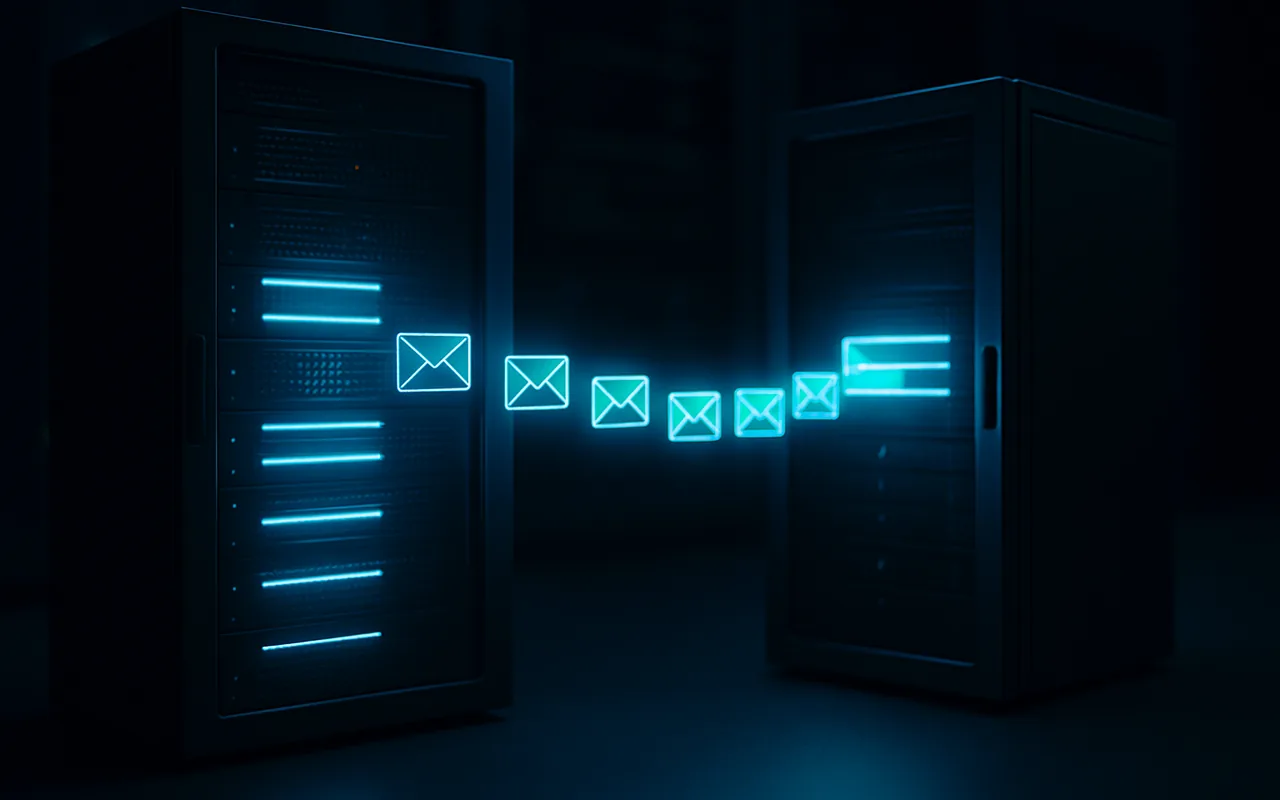
The core model is simple: a producer emits an event, an event bus or broker routes it, and one or more consumers react to it. Unlike a traditional REST API call, where the caller blocks and waits for a synchronous response, an event is fire-and-forget. The producer publishes “order.placed” and immediately moves on; the broker stores the event; the consumers — inventory, payment, shipping, email — each pick it up on their own schedule.
The component at the centre of this pattern is often a message queue or event broker such as Apache Kafka, AWS EventBridge, or RabbitMQ. Producers and consumers never talk directly to each other. They only know about the broker and the event schema. That single design decision eliminates an entire category of tight coupling that makes systems brittle as they grow.
The Three Roles: Producers, Brokers, Consumers
Think of a radio broadcast. The producer is the radio station: it transmits a signal without knowing who is listening or how many radios are tuned in. The broker is the airwaves: it carries the signal reliably across distance. The consumers are the individual radios: each one receives the same broadcast and does something with it — plays music, streams news, sits silently on a shelf.
In software terms:
- Producer — the service that detects a business event and publishes it. It does not know which consumers exist or what they will do.
- Broker — the middleware (Kafka, EventBridge, RabbitMQ, Azure Service Bus) that receives, stores, and routes events to the right consumers based on topic or subscription rules.
- Consumer — the service that subscribes to specific events and acts on them: writing to a database, sending an email, triggering a workflow, updating a dashboard.
The Four Core EDA Patterns
Event-driven architecture is not a single technique. It is a family of patterns. Here are the four you will encounter most often.
| Pattern | Key Idea | Best For | Example Tool |
|---|---|---|---|
| Pub/Sub | One event → many consumers | Fan-out notifications | AWS SNS, Google Pub/Sub |
| Event Streaming | Persistent, replayable log | High-volume data pipelines | Apache Kafka |
| Event Sourcing | State = accumulated event log | Audit trails, finance | EventStore, Kafka |
| CQRS | Separate reads from writes | High-read/write-ratio apps | Axon Framework |
Pub/Sub (Publish-Subscribe)
In publish-subscribe, one event triggers many consumers simultaneously. When a user signs up, a single “user.registered” event fans out to the welcome email service, the CRM connector, and the analytics pipeline — all in parallel, none of them aware of the others. This is the most common EDA pattern and the easiest to start with.
Event Streaming
Event streaming stores a continuous log of events that consumers can read at their own pace and replay from any point in history. Apache Kafka is the canonical example. Stock price feeds, clickstream data, and IoT sensor readings all flow naturally into streaming architectures because the event volume is too high and the history too valuable for a traditional queue that deletes messages on delivery.
Event Sourcing
In event sourcing, the system does not store the current state of an entity directly. It stores the full log of events that produced that state. A bank account balance is not a row in a table — it is the sum of every deposit and withdrawal event since the account opened. This gives you a perfect audit trail and the ability to reconstruct any past state of the system. It adds complexity, so most teams use it only where the audit requirement genuinely justifies it.
CQRS (Command Query Responsibility Segregation)
CQRS splits the write path (commands that change state) from the read path (queries that return data). The write side emits events; the read side maintains one or more materialized views optimised for how the data will be queried. The result is faster reads and cleaner writes, at the cost of eventual consistency between the two sides. CQRS is often paired with event sourcing but can also be used without it.
Benefits of Event-Driven Architecture
- Loose coupling — services do not know about each other. You can replace, redeploy, or scale any one of them without touching the others, as long as the event schema stays stable.
- Horizontal scalability — when order volume spikes, add more consumer instances. The broker distributes load across them automatically without any change to producers.
- Real-time responsiveness — reactions happen as events occur, not on a cron schedule. Fraud detection, live inventory, and notifications all benefit from this immediacy.
- Fault tolerance — if a consumer fails, the event waits safely in the broker and retries automatically when the consumer recovers. No data is lost.
- Natural audit trail — the event log is a complete history of everything that happened in the system, which satisfies compliance requirements without additional instrumentation.
When EDA Is the Right Choice (and When It Is Not)
EDA adds real operational complexity. Before you adopt it, make sure your use case actually needs it — especially if you have already split your system into microservices and are managing the coupling pain that comes with synchronous REST calls between them.
Use EDA when:
- Multiple services need to react to the same business event (a new order, a completed payment, a user action).
- You need real-time processing at scale: IoT data, fraud detection signals, live inventory, or clickstream analytics.
- You are running microservices and point-to-point REST calls between them are creating a maintenance nightmare.
- You need an immutable audit log of business events for compliance or debugging.
Do not adopt EDA when:
- You have a simple CRUD application with fewer than five services. The added operational overhead — broker infrastructure, eventual consistency, distributed tracing — outweighs the decoupling benefits.
- You need an immediate synchronous response. If the business requirement is “tell me right now whether this credit card is valid,” an event-based flow will not serve you. Use a synchronous API call.
- Your team has no experience with eventual consistency or distributed debugging. EDA failures are subtle — events arrive out of order, consumers lag, schemas drift — and require specific tooling and experience to diagnose.
Most teams adopt EDA incrementally with the help of an experienced custom software development partner — starting with one async flow (e.g., post-order notifications) before expanding to the full event backbone. For an overview of what EDA looks like in production, Confluent’s guide to event-driven architecture covers the operational patterns in depth.
Real-World Use Cases
- E-commerce order processing. A single “order.placed” event fans out in parallel to inventory reservation, payment capture, shipping label generation, and customer email confirmation. Each service runs independently; if the email service is slow, the inventory update still completes on time.
- Fraud detection. Every payment event streams to a fraud scoring model in real time. Events that exceed a risk threshold route to a human review queue while low-risk transactions proceed without interruption — all within milliseconds of the original transaction.
- IoT and logistics. Thousands of vehicle or package sensors push location and condition events continuously. Consumer services aggregate readings, detect threshold breaches (temperature, delay), and trigger alerts without polling.
- User onboarding workflows. A “user.signed_up” event triggers the welcome email drip, the CRM record creation, the analytics event, and the feature-flag assignment — all in parallel, none blocking the registration response.
- Financial services. Trade events simultaneously feed risk models, compliance audit logs, client dashboards, and regulatory reporting systems. Any one consumer can be updated or replaced without touching the trading engine that emits the events.
EDA vs. Request/Response at a Glance
| Request/Response (REST) | Event-Driven | |
|---|---|---|
| Communication | Synchronous — caller waits | Asynchronous — fire and forget |
| Coupling | Tight — caller knows callee | Loose — producer does not know consumers |
| Scalability | Scale caller and callee together | Scale producers/consumers independently |
| Real-time | Possible but requires polling or long-polling | Native — events arrive as they happen |
| Failure handling | Retry logic in the caller | Broker retries automatically |
EDA Tools and Platforms (Quick Reference)
| Platform | Provider | Best For | Pricing Model |
|---|---|---|---|
| Apache Kafka | Open source / Confluent | High-throughput streaming | Self-host or SaaS |
| AWS EventBridge | Amazon Web Services | Serverless AWS-native apps | Per-event |
| Google Cloud Pub/Sub | Multi-region fan-out | Per-message | |
| Azure Service Bus | Microsoft | Enterprise .NET apps | Per-operation |
| RabbitMQ | Open source / CloudAMQP | Traditional pub/sub queuing | Self-host or SaaS |
Challenges to Plan For
EDA introduces a specific class of distributed-systems problems. Going in with eyes open prevents most of them from becoming production incidents.
- Eventual consistency. Consumers may be milliseconds or seconds behind the producer. Your UI needs to handle “processing…” states gracefully rather than showing stale data as if it were current.
- Event ordering. Multiple consumers processing in parallel can handle events out of sequence. Partition keys on the broker ensure that events for the same entity (e.g., the same order ID) always flow through the same consumer instance in order.
- Observability. A single user action can trigger dozens of downstream events across multiple services. Distributed tracing tools — OpenTelemetry, Datadog, or similar — are not optional; they are how you debug production issues without spending days reading logs.
- Schema evolution. When you change an event schema — add a field, rename one, remove one — existing consumers may break if they were not written to handle schema drift. Use a schema registry and version your event types explicitly.
- Idempotency. Brokers typically guarantee at-least-once delivery, meaning a consumer may receive the same event more than once (for example, after a retry). Every consumer must be idempotent: processing the same event twice must produce the same result as processing it once.
Frequently Asked Questions
What is the difference between event-driven architecture and pub/sub?
Pub/sub is one pattern within event-driven architecture. EDA is the broader architectural style; pub/sub describes how events are broadcast to multiple subscribers simultaneously. EDA also includes event sourcing, streaming, and CQRS — techniques that pub/sub alone does not cover.
Is event-driven architecture the same as microservices?
No — they are complementary, not synonymous. Microservices is an approach to decomposing a system into small, independent services. EDA is how those services communicate without calling each other directly. You can have microservices without EDA (using REST calls between them) and EDA without microservices (a monolith that emits events to an external broker).
What is the most popular tool for event-driven architecture?
Apache Kafka is the most widely deployed event-streaming platform for high-throughput use cases. For serverless and cloud-native applications, AWS EventBridge, Google Cloud Pub/Sub, and Azure Service Bus are popular managed options that eliminate the operational overhead of running Kafka yourself. AWS’s event-driven architecture overview is a useful starting point if you are already running workloads on AWS.
How does event-driven architecture affect my application’s cost?
EDA typically increases infrastructure cost — you pay for a managed broker plus storage for the event log — but reduces long-term engineering cost by decoupling services. The break-even point is usually when you have three or more services that need to share data. At that point, an event broker is cheaper to maintain than bespoke API integrations between every pair of services.
Can a small startup use event-driven architecture?
Yes, but only if you genuinely have the use case. A startup with one or two services and a simple domain will add complexity without any corresponding benefit. A better starting point is a simple REST API or a single message queue for one asynchronous job. Adopt EDA incrementally as your system grows and the coupling pain becomes real — not on day one because the pattern sounds scalable.