Google Maps Now Books, Orders and Reserves for You: What Local Businesses Must Know
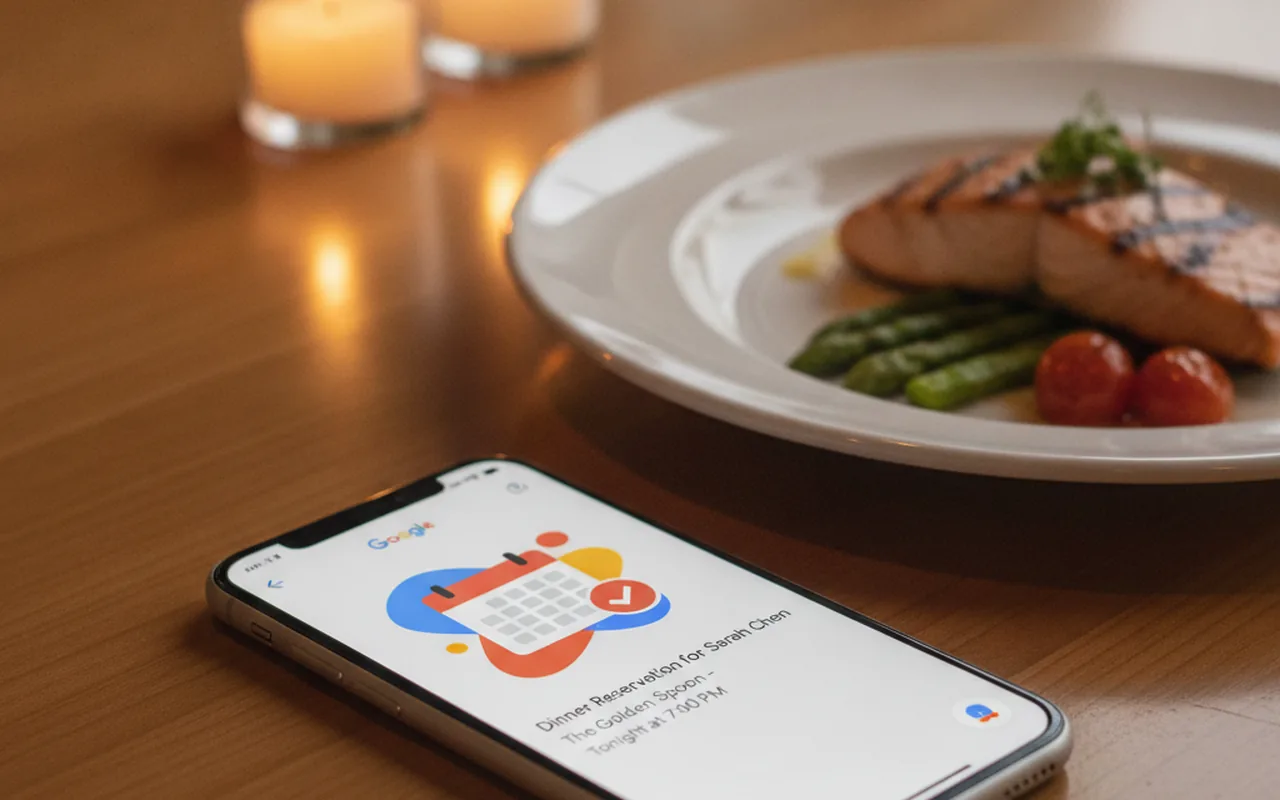
Google Maps became a booking agent on August 6, 2026. In a single announcement, Google added the ability for its AI-powered Maps assistant to order food, book hotel rooms, buy event tickets, and reserve restaurant tables — all without users needing to switch to a separate app or website. TechCrunch confirmed the launch details on the day of release, and the update is already live for Google Maps users in the United States.
For local businesses — restaurants, hotels, bars, entertainment venues, and any operator that takes reservations or accepts food orders — this is not a future capability to plan for. It is live now, and whether your business is surfaced, bookable, or invisible inside this system depends on decisions you can make today.
What Google Maps can now do
The core change is that Maps shifted from a tool that helps users find places to a tool that helps users complete transactions. The agentic features work through the conversational Maps assistant, which can now interpret requests like "find me an Italian restaurant near downtown that takes reservations for four people tonight" and respond not just with a list, but with available reservation slots and a direct booking button.
The announced capabilities fall into four categories:
- Restaurant reservations: Maps surfaces available slots from OpenTable, Resy, and Tock, matching user preferences for cuisine type, party size, location, and timing. Users confirm directly in Maps; the reservation lands in their booking platform inbox.
- Food ordering: The assistant identifies nearby restaurants offering delivery or pickup based on dietary preferences or specific dish requests. Food ordering is powered by integrations with Square and Toast at launch, with Uber Eats added in a subsequent rollout phase.
- Hotel booking: Maps can compare available rooms, filter by dates and amenity requirements, and surface prices from Google Hotels partners. Booking completes inside the Maps interface for participating properties.
- Event tickets: Concert and event ticket availability from select ticketing platforms will surface in Maps for location-based searches like "concerts near me this weekend."
The unifying mechanic is that Maps does not just surface options — it carries the user through the conversion step. This is a meaningful shift from the discovery-plus-redirect model that defined local search for the past decade.
Why this matters more than it looks
Google Maps already handles approximately 1 billion location-based searches every day. A non-trivial percentage of those searches have transactional intent — users looking to book, order, or visit. Until now, every one of those searches resulted in a click to an external site to complete the action. The August 6 update removes that intermediate step for a growing share of transactions.
The implications for local businesses are two-layered. First, any business that is not integrated with the supported booking platforms cannot be booked through this channel, regardless of how strong its Google Business Profile is. Second, businesses that are integrated gain a conversion path that previously required a user to navigate away from Maps, load a third-party site, and complete a multi-step checkout — steps at which abandonment is high.
This connects directly to the broader agentic commerce shift underway across Google's products. The Universal Commerce Protocol, which lets merchants plug into Google AI Mode's purchasing flows, shares the same architectural principle: AI completes the transaction rather than handing it off. Google's Universal Commerce Protocol for AI Mode and the new Maps booking features are parallel tracks in the same strategic direction.
Integration map: which platforms connect where
| Category | Integrated platforms at launch | Coming later |
|---|---|---|
| Restaurant reservations | OpenTable, Resy, Tock | Expansion to additional reservation systems |
| Food ordering | Square, Toast | Uber Eats |
| Hotel booking | Google Hotels partners | Broader OTA integrations |
| Event tickets | Select ticketing platforms | To be announced |
If your restaurant takes reservations through a system not on this list — a proprietary booking widget, a less common reservation platform, or a phone-only reservation system — you are not bookable through Maps today. That is not a permanent state; Google's partnership footprint will expand. But it is your immediate competitive gap.
What restaurants need to do
The action checklist for restaurants is specific. First, verify that you have an active, connected account with OpenTable, Resy, or Tock, and that your Google Business Profile is linked to that account. The Maps booking feature draws reservation availability in real time from these platforms — if the connection is broken or the listing is outdated, the booking slot simply will not appear.
Second, audit your GBP for accuracy. The agentic assistant uses structured data from your Business Profile — hours, cuisine type, price range, dietary options, and booking link — to match your restaurant against user requests. An incomplete profile means the assistant either does not surface your restaurant or surfaces it without a booking option. The Gemini integration in Google Business Profiles is already using these same structured fields to power local recommendations; the Maps agentic booking update deepens their importance.
Third, consider the food ordering side separately. If you offer delivery or pickup and are using Square or Toast for point-of-sale, confirm that your ordering integration is live and that your menu in Maps is current. Outdated prices, missing items, or closed hours that have not propagated to Maps will create failed transactions — which trains the algorithm to surface you less frequently.
What hotels need to do
Hotels operating through major Online Travel Agencies (OTAs) that feed into Google Hotels — Booking.com, Expedia, Hotels.com — are likely already surfaced in Maps booking results, since Google Hotels has long aggregated OTA pricing. The shift is that users can now complete the booking without leaving Maps, which means the quality of your Google Hotels listing matters more than it did before.
Ensure your property's rate parity is maintained across OTA feeds. When the Maps assistant surfaces room options, it presents comparable properties side by side with pricing. A rate that appears significantly higher in your Google Hotels listing than on your direct booking site — because rate parity rules vary by market — can cost you the conversion to a competitor with more consistent pricing. Hotels with a direct booking link verified in Google Business Profiles may benefit from Google surfacing the direct rate alongside OTA options.
For smaller boutique hotels or B&Bs not yet participating in major OTA feeds, this is the right moment to evaluate adding a channel that connects to Google Hotels. A mobile app development team with hospitality API experience can help build or integrate a direct booking channel that feeds real-time availability to Google's systems, reducing OTA commission costs while staying bookable in Maps.
The visibility shift for non-transactional businesses
Not every local business is directly affected by booking and ordering features — but the underlying logic of how Maps surfaces results is shifting in ways that matter for everyone. As Google Maps becomes a transaction-completion tool rather than a discovery tool, the ranking signals it uses are evolving. Businesses with active booking integrations, complete GBP profiles, strong review velocity, and accurate structured data will be favored by a system that needs reliable data to confidently complete transactions on users' behalf.
For businesses in categories not yet part of the agentic booking rollout — salons, gyms, healthcare practices, retail stores — the near-term implication is to audit your GBP with the assumption that agentic booking is coming to your category. The businesses that invest in accurate, complete, integration-ready profiles now will have structural advantage when their category integrations go live.
The competitive angle: agentic vs. direct
Before this update, a user who found your restaurant on Google Maps still had to take three to five steps to complete a reservation: click your website, navigate to a reservations page, find a booking widget, select a date, and confirm. Every step introduced friction and abandonment risk. The agentic Maps booking removes most of those steps.
The competitive implication is that businesses with friction-free booking paths — those already live on OpenTable, Resy, or Tock with accurate GBP data — will convert a meaningfully higher proportion of Maps-based discovery queries. The gap between a business that appears in Maps and a business that is bookable in Maps is about to matter in measurable revenue terms.
For restaurant operators who have resisted third-party reservation platform fees, the calculus is changing. The question is no longer just whether to pay OpenTable's cover fee; it is whether to be present in the discovery-to-booking pipeline that Google controls for the segment of customers who search via Maps.
FAQ
Does my business need to do anything to appear in Maps agentic booking?
Yes. Your business must be connected to one of the supported booking platforms (OpenTable, Resy, or Tock for restaurants; Square or Toast for food ordering) and your Google Business Profile must be accurate and linked to your booking account. Businesses not on a supported platform will not appear as bookable in this flow, regardless of how strong their Maps presence is otherwise.
Will Google charge businesses for bookings completed through Maps?
Google does not add a booking fee on top of what the integrated platforms already charge. Restaurants pay OpenTable, Resy, or Tock their standard cover fees; food ordering transactions go through Square or Toast at normal processing rates. Google's role is to surface the booking opportunity, not to add a transaction layer on top of existing platform agreements.
Does this affect how Google Maps ranks local businesses in search results?
Google has not confirmed an explicit ranking boost for bookable businesses. However, the practical reality is that the Maps assistant is more likely to surface businesses it can confidently book on behalf of the user. A business that is integrated, active on a supported platform, and has a complete GBP profile gives the AI more signal to work with. Treat bookability as a de facto ranking factor for transactional searches.
What if I use a reservation system not on the supported list?
You are not bookable through Maps today. Monitor Google's partner announcements, as the integration list will expand. In the interim, ensure your GBP has a direct booking URL that points to your reservation page — users who find you in Maps but cannot book in-app may still convert through a direct link if it is easy to access.
Is this feature available globally or only in the US?
The agentic booking features launched in the United States in August 2026. Earlier agentic reservation tests ran in India, and Google has indicated global expansion is planned, but specific timelines for non-US markets have not been announced.