AI vs Search: Who Wins Each Stage of the 2026 Buying Journey
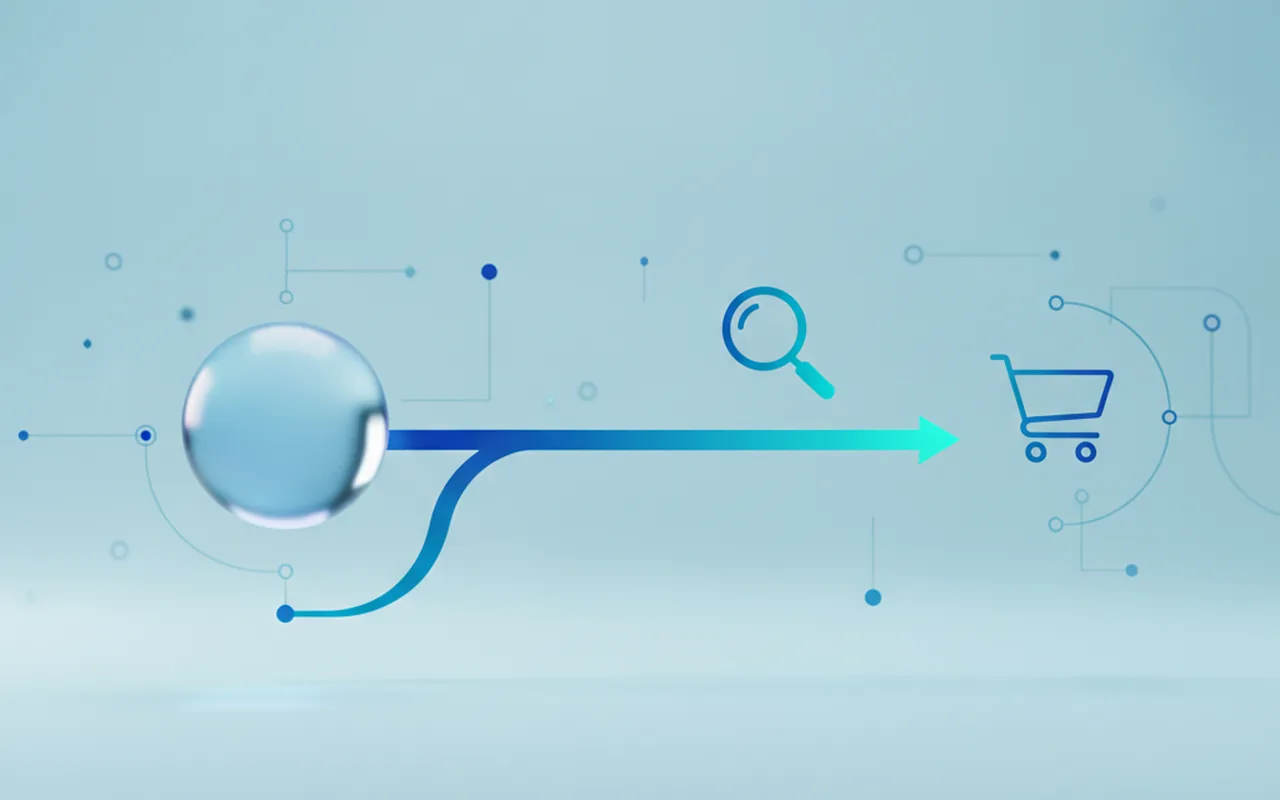
Two studies making the rounds in mid-July 2026 finally put numbers on a shift marketers have felt for a year: buyers now start their journey inside an AI chatbot but still finish it in a search engine. Similarweb's Market Research Panel found that 35% of US consumers open their product research with an AI tool versus just 13.6% who begin with search — a 2.6x gap at the discovery stage. Yet by the moment of purchase, that lead nearly evaporates: 24.3% lean on AI while 22.1% return to search to find where to buy and at what price.
In parallel, Braze's 2026 Customer Engagement Review reported that 19% of consumers already use AI agents to interact with brands, a figure the firm expects to reach 46% by the end of 2026. Put together, the data describes a split funnel: AI owns the top, search closes the bottom, and the brands that win are the ones present in both. Here is what the numbers say and how to structure your content, product data, and measurement around them.
The split funnel, stage by stage
The headline is not "AI is replacing search." It is that AI and search now specialise in different jobs. Similarweb measured which tool US consumers reach for at each stage of a purchase, and the balance tips as intent hardens.
| Journey stage | Start with AI | Start with search | What it means |
|---|---|---|---|
| Discovery | 35% | 13.6% | AI shapes the shortlist before search sees any intent signal (2.6x lead) |
| Evaluation | 32.9% | 15% | AI still leads while buyers compare options and read up |
| Purchase | 24.3% | 22.1% | Near parity — search reclaims ground for price and "where to buy" |
Read the table top to bottom and the story is clear: the earlier the stage, the more AI dominates. That matters because discovery is where preferences form. If an AI assistant never surfaces your brand while it is building a buyer's shortlist, you are not even in the race by the time that person opens Google to compare prices. The upper funnel has quietly become the most contested ground in search — and it is the ground classic SEO reporting is worst at seeing.
Why AI-referred visitors are worth more
The split funnel would matter less if AI sent low-quality clicks. It does the opposite. Similarweb found that visitors who arrived at a brand's site via an AI chatbot viewed roughly twice as many pages and spent about twice as long on site as visitors from standard channels. And consumers who received a specific brand recommendation from ChatGPT were 2.5x more likely to visit that brand over its competitors.
The reason is intent. A chatbot visitor has usually already described their problem, had it reframed, and been handed a curated shortlist — so they land pre-qualified rather than cold. This mirrors what standalone-referral data has shown all year: as our breakdown of where AI referral traffic actually comes from details, ChatGPT drives the overwhelming majority of trackable chatbot referrals, and those sessions behave like high-intent shoppers, not casual readers. Winning a citation in the discovery phase is not a vanity metric; it is a direct line to your most valuable visitors.
Where search still wins — and why that's good news
The comforting half of the data is that search does not disappear; it specialises. At the purchase stage the AI lead shrinks to about 2 percentage points, and consumers explicitly told Similarweb they trust AI for discovery but return to traditional search for deals. When it is time to confirm a price, check availability, read recent reviews, or find the exact retailer, people still open a search bar.
That is good news for two reasons. First, it means the SEO fundamentals you already invest in — fast pages, clean product data, trustworthy reviews, accurate pricing — remain the closing tools of the funnel. Second, it means the two channels reinforce each other. AI Overviews and organic listings both pull from the same well-structured, authoritative pages, so a page built to rank is also a page built to be cited. The recent June 2026 spam update is a reminder that this organic foundation is still shifting under everyone's feet, and that the sites rewarded for genuine quality are the ones AI tools quote most freely.
The agent wave is coming faster than most plans assume
If the split funnel describes today, Braze's data describes the near future. AI agents — assistants that don't just recommend but actually browse, compare, and transact on a user's behalf — are moving from novelty to habit. Braze put current adoption at 19% and projected 46% by year-end, with 35% of consumers naming "the chance to negotiate better deals and discounts" as their reason to embrace them.
But the report also flagged a trust plateau that should temper the hype. Some 27% of consumers refuse to share any data with AI agents even in exchange for a better experience, and 43% say they would abandon a brand entirely if their data were misused. There is a perception gap underneath it all: 93% of marketing leaders believe AI helps them understand customers accurately, while only 53% of consumers feel brands actually predict their needs. Agentic commerce is arriving, but it will reward brands that earn trust with clean, permissioned data — not those that assume automation forgives sloppiness.
How to win each stage: a practical playbook
1. Compete at discovery with quotable, answer-first content
AI's 2.6x lead at discovery is the single biggest reason to invest in Generative Engine Optimization. Make the crawlers behind ChatGPT, Gemini, and Perplexity welcome in your robots.txt, put your key facts in server-rendered HTML rather than JavaScript, and write passages that answer a question in the first sentence so they are easy to lift and cite. Our full guide to optimizing for AI search walks through the citation mechanics in detail.
2. Make your product and pricing data machine-readable
Because search reclaims the buyer at the price-comparison stage, the pages that close the deal must be trivially easy to parse. Put prices, specs, and availability in the HTML and in Product schema — not buried in images or behind "contact us" forms. Machine-readable pricing now doubles as a discoverability feature: it is exactly what an AI agent needs to shortlist you and what a searching buyer needs to choose you.
3. Treat high-intent landing pages as conversion surfaces
AI sends fewer but far more engaged visitors, so the pages they land on carry disproportionate weight. Internal search results, product pages, and comparison pages should load fast, guide a cold-but-qualified visitor toward a decision, and never dead-end in an empty state. Design these as if every visitor already told a chatbot what they want — because many of them did.
4. Measure the two channels separately
A blended "organic traffic" number hides the split funnel completely. Segment AI referrals from classic search, and watch discovery-stage assisted conversions rather than last-click alone. Google's own tooling is starting to help here — see our walkthrough of the Search Console AI performance report for how to isolate AI-surface impressions from ordinary organic clicks.
5. Earn trust before agents transact for your customers
With agent adoption on track to more than double this year, the brands that will benefit are those with permissioned first-party data and transparent value exchange. Audit what you collect, why, and how clearly you explain it. In an agent-led world, trust is not a brand-safety checkbox — it is a distribution advantage.
The takeaway
The 2026 data does not crown a single winner. It redraws the map: AI now owns discovery and evaluation by a wide margin, search still closes the sale on price and availability, and agentic commerce is arriving fast but gated by trust. The losing move is to treat this as an either/or bet. The winning move is to be present at every stage — cited by the chatbot that builds the shortlist, ranked by the search that confirms the deal, and trusted by the agent that may one day click "buy" on your customer's behalf. Own the whole funnel, because your buyers now travel all of it.